What happens when something that works at the individual level is ready for the system? In this episode, we explore the shift from coaching individuals and families to stepping into schools. For years, this work has focused on restoring readiness at the human level—helping students, parents, and educators move from overwhelm into flow.
Now, that same work is expanding. ReadinessOS™ is being brought into its first school. This marks the transition from one-to-one transformation to system-wide change—from private coaching conversations to classrooms, staff rooms, and entire learning environments.
We break down what’s been missing in education, why so many solutions fail to stick, and what becomes possible when you stop pushing performance and start restoring the system underneath it.
This is no longer just an idea—this is implementation.
---
Watch the episode here
Listen to the podcast here
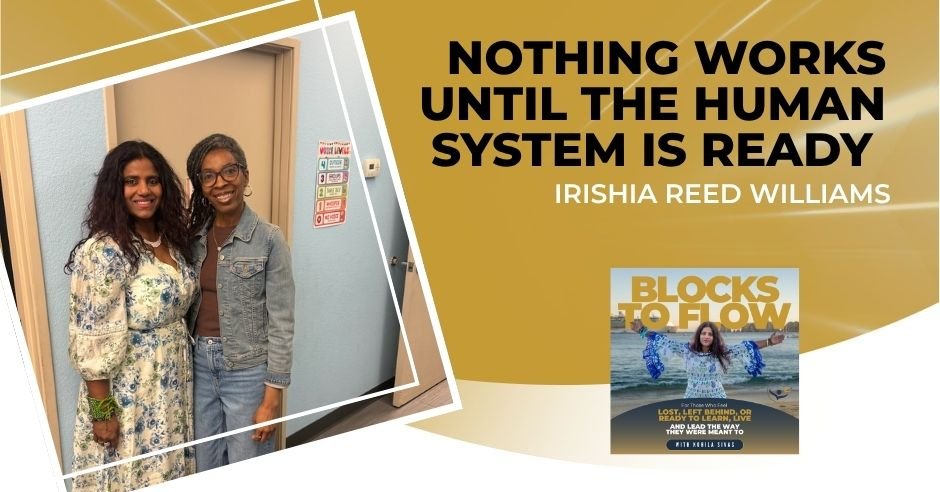
Nothing Works Until The Human System Is Ready With Irishia Reed Williams
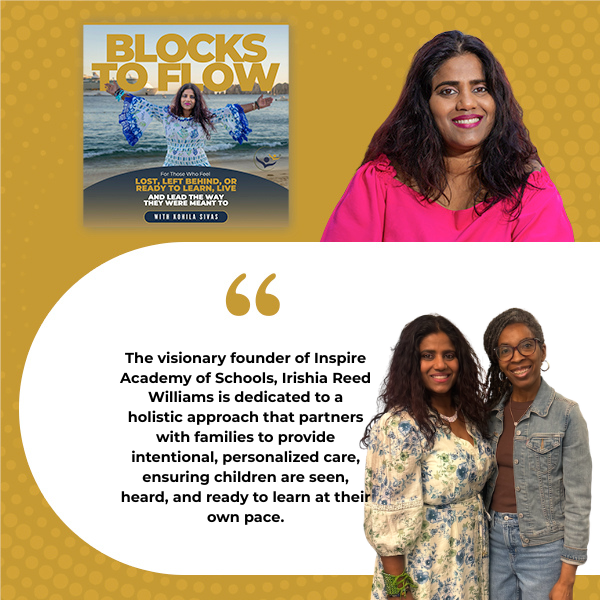
I am here with Irishia at her school. I am excited to introduce her and our collaboration. Thank you for having me.
Of course, Kohila. Thank you for having me. I appreciate it.
Tell us about the vision behind this school that you have created.
Vision Behind Inspire Academy Of Schools
The vision behind Inspire Academy of Schools was really born out of the COVID-19 closure that happened in 2020. As a special education teacher, I was with a district during that time. I was texting, emailing, and calling families for assistance on how to support their children while they were home. Luckily, our district just implemented the one-to-one device. Working with special needs students, that has been introduced.
They exactly know how to navigate, I would say, Google Classroom or Class Dojo. Our students were lucky enough to have had a year ahead of time to be able to learn and practice those things. It was a seamless transition for me to go from a teacher in a classroom to an educational consultant with parents creating homeschool programs for them during that time. That is really where Inspire Academy of Schools was born. I just extended it out to now we are a learning center, or you will also hear the term micro school, that supports kids who are homeschooling or doing online learning with more educational support.
This year, you are expanding.
Yes, we just literally got an email giving us the clearance for zoning and permitting. We will be able to open our learning center in Glendale, Arizona, starting this summer. We are super excited to be able to support another community here in Arizona.
Congratulations.
Thank you. It is so exciting.
I just know how that feels. It is your baby. It is growing. What is it that schools can do that you already provide here?
What can schools do?
Cannot do.
Core Difference Between The School And Traditional Education Systems
The number one thing that we do that schools cannot do is show the patience and care to kids and families, and provide a space where we meet kids where they are, and then we help to build their skills from there. Whether it is academics, social-emotional development, or executive function, we have a small learning environment to be able to facilitate a lot of these things, sometimes one-on-one or in a small group. Public schools, with the pacing requirements and the testing requirements, do not really have the time to be that intentional and specific on kids' needs as we can.
The number one thing we do that schools often can’t is show patience and care for kids and families, creating a space where we meet students where they are and help them build skills from there.
You are also adding to this school another area that you were talking to me about, where kids have intensive needs that you want to help them out because parents do not know what to do with them either, right?
Exactly. We do have families that reach out to us that have students who have very explosive behaviors, whether it is self-injurious behaviors, injury to others, or property damage that we would love to be able to support, but do not have the staff that has the training to support those needs. If there is a way that we can bring in outside programming to the families to help mitigate some of those behaviors, that is 100% what I have been searching for. Hopefully, I found it with your program.
How did you find out? How did you come into my world?
I am really big on social media. I follow a lot of programs that are similar to mine. When I am looking through reels or ads and things, your ad just popped up on my page. I saw your video, and you were just talking about parenting and kids who are having challenges in school. I was like, "This looks interesting." Definitely along the lines of what we do.
I just kept watching and listening, and it really started to resonate with me how you work with parents and children, because that is one of the major focuses that we have here, which is that we partner with parents. Yes, I am an educational expert, but I want to bring that expertise to our families so that they, in turn, can bring their expertise on their child to us. We form a collaboration, a team to help bring the goals and skills forward for their children.
When I met you, I was in love with what you were already doing. I saw how we could be the prerequisite to what you are doing and getting the children into a state of learning. It is a state. We assume that they come ready. Most students do not. The other part that we focus on is making it holistic. As you just mentioned.
That really drew me to your program because one of our pillars is holistic education. Not just ABCs and 123s. How do we advocate for ourselves as children? They need to have a voice. Whether it is using an AAC device, an augmented communication device, or actually using their voice and their words, we stress the importance of being able to advocate for yourself. We look at the child as a whole and not just from an academic lens.
There is so much other stuff, such as sleep. Who they hang out with. What do they consume besides just not putting into their body, but even through their eyes?
One hundred percent. We work with a student who came to us last year, whose attention was everywhere. Behavior was noncompliant, and we really worked with the family to streamline the nutrition, which then, in turn, helped with getting more sleep. Now, seeing him is night and day from day one to now, a year later, being in our program. We really pride ourselves on bringing in the full child and not just focusing on one or two things.
That is why the education system is falling apart, because we are not looking at all the aspects of the human body. This is a human living body. If we do not take care of it and if the resources are missing, how can I function?
Yes, they focus on academics, which is important. As you said, if I am not ready to learn or in a state where I can learn, if I did not have breakfast that morning, or if I did not shower the night before, those things matter to the body and the brain. I know funding and all of those things come into play, but other countries do education well, so it can be done. It is just where our priorities are.
We need to look at it as a requirement to learn. These are requirements to learn. You cannot build a building without a strong foundation. We keep building it. They are falling later in life to look at all the adults who are looking for personal development and trying to fix themselves in their forties and fifties. Why? It’s because we have not learned what we could have learned when we could have learned, which was the ages of 8, 9, 10, 11, and 12.
You start to see those holes. “I did not know there was a hole there.” A crack in your foundation can be detrimental to a lot of things that you are trying to do as a young adult or an older adult. We are really trying to fill those gaps when they are young so that when they do get older, there is less that needs to be filled.
I noticed in the naming of your school, you did not say school, you said schools. You have already planned to open multiple branches.
I definitely did have dreams of grandeur of having more than one location for sure.
What is that number in a few years? What does that look like?
The number that has been continuously in my brain has been five. We are working on number two, which is a dream come true, honestly. We have been working night and day to try to bring forward our particular brand of support to our communities here in Arizona. Hopefully, next year when we are having this conversation again, we will be talking about location number three. That would be amazing for four or five.
We can always dream. We can get it done. What do you hope this partnership with Wholistic Success Codes, our coaches, what are you hoping that would bring to your space here?
Holistic And Flow-Based Learning Approach, Including Micro School Model And Readiness For Learning
I am definitely hoping that we are able to help more families on the parent side and on the child side be able to function more in flow with themselves and with each other. I remember when my kids were younger, one of my children had difficulty in school, and I had to first look inward on my parenting style, on what I was doing or not doing for that matter, because boundaries were hard for me. I had to build those skills within myself first. I could look at my child and say, "These are our boundaries.
These are the things that we need to do and how we are going to do them." I love your approach to working with bringing parents into flow and then bringing children into flow so that the family can be in flow because I know that is what happened with my life and my children. I want to be able to bring that forward to our community 100%. With that flow happening, then learning will 100% explode after that. I am just super excited to see the process and see all the improvements that happen with our students.
That is the missing link in our education system, and how we look at things right now is that we always want to improve the grades. That is the byproduct of all of this stuff you just talked about. If we clean up all of this and get them into flow, the result will always be the child achieving. There is nothing else going to happen other than achievement.
Once you get your body ready, and then you put it in the situation where it can do what it is designed to do, then the sky is the limit.
Once you get your body ready and place it in the situation it was designed for, the sky’s the limit.
Importance Of Readiness, Flow, And Foundations Before Academic Performance
I am excited to grow with you, and I am glad you saw the difference. I was just coming from a summit that was for mental health related to school. There were more than 350 professionals there. All of them have strategies. We all have lots of beautiful strategies, all these techniques, all these new ways of planning and executing. The foundation is not ready. It does not matter what we have put on top.
That is so true. We have had a few kids come to us this year where we just really had to settle them in, not give them too many demands, not too many academic tasks. You are just here, you are listening, you are engaging in the community with the students, and you are engaging with different educational things and conversations with adults, just to get them comfortable and then ready to learn. Sometimes it takes a week, two weeks. It really just depends on the child. We are really flexible in building in the acceptance and tolerance of being in a program like this, because it is very different from traditional school.
You just have to be ready. You are ready. “Let us go.”
I have had people come and do visits and tours and things. When students are here, they are just like, "It is just so calm in here." It is so different just walking in the door. You see kids buzzing and doing things, and everyone is on task. No one is doing the same thing. Some kids might be doing the same thing, but it just flows, and it works, and there is an ease to what is happening. It really hits me in the heart because that was my plan. That was my desire to have a comfortable space where kids can come and learn.
Absolutely an accepted scene and given the space to explore.
At their pace. That is the part that is so important.
It is working. It is possible. We always say in school, it is not possible. To the scaling, it is not possible. Everybody says, "How can we let everybody learn at their own pace?" It is not possible, but you are doing it.
Yes, we absolutely are. It is flowing, and it is beautiful. Parents are happy and excited. Kids are excited to come to school. They are like, "We are coming to school." They have friends. They are learning new things in a very relaxed, but still rigorous environment.
Beautiful. I want to ask what your childhood was like. Why did you become a teacher? What was the inspiration behind that?
The inspiration behind that was both of my grandmothers, who were in education in some way. They always sat down with me, sat down with my cousins, and made sure that we knew our ABCs, one, two, three, how to cook, and do different things like that. Having that experience really led me to want to do the same thing. I started working with kids when I was in high school. We had a local pool. I went to the pool owner and was like, "Can I be the supervisor here?" I know CPR. I know all these things, water safety. I would just watch the local kids at the pool.
I was just like, "This is so cool," watching these kids, teaching them how to swim. It was really amazing. Just on my college journey, after college, I just really took to education and seeing the kids' light bulbs go off when they learn a skill that we have been practicing, and they may have cried about because it was hard or a challenge for them. Just seeing those light bulb moments just really lit me up. I continue to have that love for kids' learning. Carrying that forward through this process of learning center, the micro school has just been a dream come true for me.
Why did you choose special educator? There has to be something else going on.
Special education was actually put upon me.
I learned it. I had a lot of patience.
I was actually very doubtful of special ed because I had never been in a special education classroom before. My best friend had been working for the Los Angeles County. She had been working with special ed kids for a few years. She was telling me that the county has this program where if you have a bachelor's degree, you can get your teaching credential, but you have to work with kids with needs. I was like, "I do not know if I can do that." She was like, "You will be fine." I applied, I got into the program, but before I started actual teaching, I got hired as a paraeducator so that I could get into the classroom and start to experience working with that population. It is history. I just fell in love with working with the students because in your mind, you are thinking all of these things about kids with needs, and knowing that back in the day, they used to call them teachable or unteachable. Just all of these presumptions about the population were in my mind, but once I got in there.
Personal Journey Into Special Education And Belief That All Children Are Capable Of Learning Through Connection
What is the one thing that you had to learn how to connect with them? The most important skill is connection.
The connection actually came very naturally. That is what I am saying because they are kids. They are no different than any other child. They are all children.
Children in special education are no different from any other child. They are all children
Sometimes they might test you. Now they want you to make sure that you will stay.
It’s very true. I was working with kindergartners the years before, and they were typically developing programs. There were challenges there, too. There were almost 30 kids in a class. You have three, four, and five-year-olds running around, and each kid needs something different. I had already had that training in working with kids. Moving into special education, because I had a love for kids, it did not feel any different.
In fact, it makes it powerful because you see how they learn and the differences, and then you do not have to change anything. I never changed it. I was also a special educator and a teacher assistant as well. I had one-on-one time with a lot of students. A lot of things I have developed over the years were through them, watching them. We would always say we have to adapt, but then I would do the same thing with our typical kids. It is no different.
It is just like you said, it is not really different. It may be a different presentation. It might be a different tone or pace, but it is still the same.
You could, but you do not have to finish it at the end of this period. You can have two periods to finish it. It does not have to be.
Bringing in those accommodations just really helps our students and our children learn at their own pace. That is the one switch from a kindergarten classroom to a special education classroom. It is supposed to be designed specifically for them. Differentiating and accommodating in different ways.
I just fell in love.
That was in 2007, and I never look back.
Now that is paying off here. All of the work you have done there is now flowing into here.
It absolutely is. We are supporting fifteen families who have multiple children or single children that come to us throughout the week and who have been here with us for some two years, some who are finishing out their first year with us. Just being able to really support communities and families has been a blessing for us. That is the goal that I had.
You are a blessing to them because if you think about it, if I am a parent, I take my child out for whatever reason I took them out for. I get panicked. As a mom, I do not know what to do because I am not an educator. I had emotions to take them out in the first place. A lot of it is done by emotions. We get pissed off, or we have been in a cycle of repeating something, and we are just at the end of it. We are tired of it, and we want to take them out. We really feel like a lot of parents I talk to also just freeze. What do I do now? Am I going to screw up my kid's future now that I do not have a real school? You take that fear away.
I do.
I know you do.
I do not give myself enough credit for that.
I am giving it to you.
Thank you. I appreciate it because I do. I have some parents who, when we do team meetings, which we do once a quarter.
You are like a lifesaver. You make them go to bed and sleep.
They can get up in the morning and know that when they take their kid to the program, they are going to be safe, they are going to be seen, they are going to be heard, and they are going to get all of the things that they need.
It is a blessing. Micro schools, for those who do not know what micro schools are, are small versions of a school, but then it is very dedicated and customized. As you say, the child gets to explore at their own pace, and they are seen and heard.
That is how our micro school operates. There are other versions. Multiple micro schools internationally that operate in different spaces on different levels. They are all geared towards a specific community and to support them in the way that the community desires to be supported. We have a lot of families that reach out to us. Some are like, "That is interesting, but I am really looking for something more like this." We are like, "Blessings." If I can give you a referral, I will hand the referral because not every program is for every person, but the ones that this program fits specifically for will find us and will love us.
That is alignment. You cannot serve anybody. It does not work. Thank you. I am excited for this partnership. I cannot wait to do both sides. I want to collaborate with you to talk about what that looks like for the program, with the students who are already in flow, but how can we make them flow more? The other one that you want to start with is students who have been kicked out of school or suspended, or those with explosive behavior. How can we support them to bring them into the main room?
Perfect. I am excited for it as well. Thank you.
Thank you. I will see you guys in another episode. Thank you so much.
Important Links