
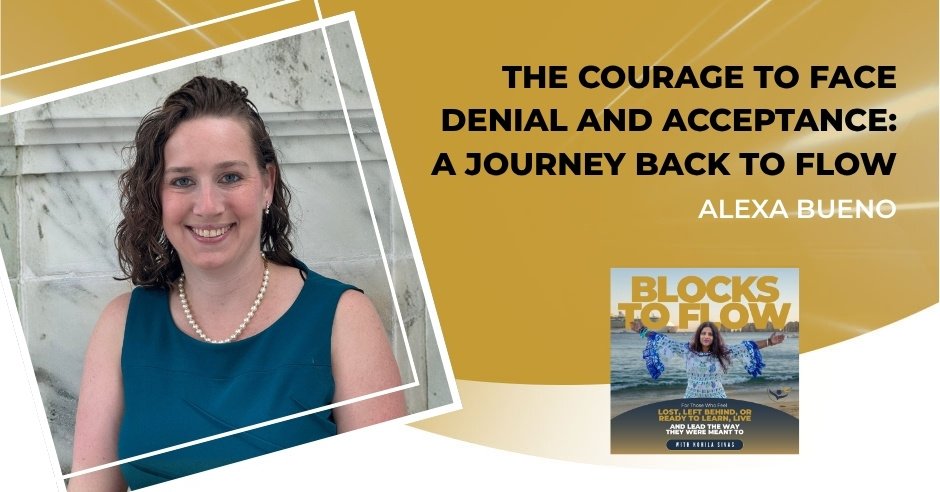
Denial and acceptance are two sides of the same emotional coin that shape how we move through life. In this heartfelt conversation, Coach Alexa Bueno shares how years of denial—from masking emotions as a young athlete to facing her son’s autism diagnosis—became the greatest teacher of all. Through acceptance, she learned to breathe again, parent with compassion, and reconnect with her authentic self. Her story reveals that peace and healing begin the moment we stop denying our truth.
—
Watch the episode here
Listen to the podcast here
The Courage To Face Denial And Acceptance: A Journey Back To Flow With Alexa Bueno
The Power Of Three: Alexa’s Grounding Breath Exercise
Coach Alexa, welcome. How are you?
I’m wonderful. Thank you for having me.
I have a ritual of starting our show with the most important thing we can all do to bring us, ground ourselves and make us presents here because we’re so busy, is to do a breeding exercise. That’s how I start my show. Is there one that you like to do?
I like to do 3D bath grounding. I do that frequently in my house with my kids, too, even.
Can you explain to us what that is?
It is just taking three simple deep breaths in through your nose and holding for two and out for a count of four. It settles you and you can feel yourself relax and we do it three times. It is very helpful.
You do it with your kids?
I do. They’re young but they do it.
It just drops your shoulder because you’re worried or frustrated or anxious all the time about what’s next. Even kids are. That’s awesome. Let’s do that three times. Do you want to lead us?
With inhale, I tend to do two but again my kids are young, so we do two. We can do it for four and out for four. Inhale for four, 1, 2, 3, 4 and out for four, 1, 2, 3, 4. We’re going to do that two more times. In for four, 2, 3, 4 and out for four, 2, 3, 4. Once more. In for four, 2, 3, 4 and out for four, 2, 3, 4.
Thank you. Do you feel grounded? I am.
I always feel my shoulders come down with it. I don’t ever realize how high up they are in my ears until I do these exercises.
Unpacking “Blocks-To-Flow”: Alexa’s Denial Regarding Her Son’s Autism
You’re a certified blocks to flow coach, Alexa. When you think about the phrase blocks to flow, what moment in your life comes to your mind first?
I think about the biggest block to flow in my personal life was a little bit of denial I had when it came to seeing the big picture with my son who is autistic. Even though I come from a background of special education, I was very much in denial about him being autistic. I kept saying, “No. That’s not him.” I could explain away every characteristic and it was blocking me, my son and my husband from being able to get him the help and moving on to more in life.
I was spending so much time focusing and fixating on all these little things of what was stopping and like, “No, that’s not it. I’m fine.” Finally, when I was able to release that block and be like, “He is who he is. This is who he is. We need to heal as a family and move on.” I was almost like a dam in the water that held all that water until when the beavers built the dams and they let him go. It’s just like that gush of water. It pours out. It was like this big relief of like I could breathe, relax and we could move forward to this journey.
That block denial, that’s normal when parents see it or something’s not looking right. The milestones maybe are not matching with other kids and your son or other sons or daughters are with other kids. You can see the difference in what’s going on. As a mom or dad, we picked that up then we start wondering. Now, I want to ask you that denial. Is that something you just had with that incident? Was that before too in your path and in your past?
Denial has always been a big block of mine. Whether it’s denying that there’s a problem or there’s something wrong. It’s a block that’s still pops up. Even things that are simple where my husband will say to me, “What’s wrong?” “I’m fine.” He’ll say to me, “You’re not fine. You’re not okay.” It’s something I fall back on where I have to be fine. Let’s just shove it to the side. Let’s deny that anything’s wrong and just move forward.
What do you think that originated from?
I think it originated from when I was younger that you don’t want to disappoint people. I’ve always been that big people pleaser. If something’s wrong then, I’m just appointing someone. That I can’t be perfect. I have this perfectionism thing that goes on. It’s something that is as much as I try and I come so far with it. That’s the thing with blocks. We are going to free them. They’re always going to reappear for us sometimes, but it’s about knowing how to move past them into flow. Being able to do that check in for me and be like it’s okay to not be okay. It’s okay to not be fine.
Blocks will always reappear, but it’s about knowing how to move past them into flow.
The Pressure To Be Perfect: Figure Skating’s Impact On Emotional Expression
Up until that point, you don’t have the awareness of, “This is what I’m doing. This is the cover up.” Denial is a cover up that comes. It covers it up and I just have to pretend I’m okay when I’m not. Let’s go back to the past again. When you were young, did somebody else make you feel or tell you that you have to always be okay or did you just take the negative in your hand?
Some of it comes back to when I was a very competitive figure skater. When you go on to the ice, you are expected to be perfect. You fall, you get up and you smile. You get up and you do this. You move on. The performance has to be perfect. I skated competitively for almost many years. It was this pressure of, I don’t want to let my coaches down. If I showed emotion, I would get in trouble.
It was, you can’t be angry. Even if you mess up, you have to go on. There’s no addressing mistakes. Sometimes in sports, that happens that you do need to get up and move on. There’s not that reflection piece of, it was okay that I made that mistake. It’s okay to cry, be frustrated and be upset. You just had to be okay. You put the makeup on. You go out there. You say hi to everyone that came to watch you. You have to be graceful. There’s no room for your emotions.
It’s a huge conditioning. With what conditions?
I mentally wasn’t prepared. No one met me I was mentally. Mentally, I might have been thirteen years old, but I had been so conditioned at one point. Thirteen was very rough for me to smile that I would then be this explosive mess by the time I got home. I was yelling at everyone. I was upset. I was anxious about school. I wasn’t even in school that much because I was at the ice rink. At the ice rink, you had to be perfect. Nobody took a second to say, “Are you okay?” When you’re at the ice rink or when you’re there. Is this not a good idea now? You can just cry about it.
Do you think looking back in that sport, they could include that? Also to have time to release because it’s if it’s okay and get a goal. To have that conversation would have helped you, right?
It would have helped me tremendously to know that it was okay to be upset and not have everyone’s staring at you. It was okay to make that mistake and finish your performance, but then let’s get off the ice. You need to have that cry moment, that discussion and that breakdown. Coaches aren’t trained with things like in a lot of sports. I think as if they want to coach higher up that they should be in a sense. I know now that you have to take different tests.
I coached for a little while but I’ve taken a big step back. It’s been over ten years. You have to take all these courses and learn how to be the best coach. There’s nothing in those courses about how to address the mental health of your competitors or your students. That’s a big thing that needs to be addressed.
What was it like on the other side before you begin living in the close state, the value and the experience? What was the feelings like? What were you living with? You said explosive.
I would feel very trapped and I’d feel like no one understood. I felt stuck and then I would yell. I would explode or then I would do things. I would get so angry that I would curse. It was, “You can’t do that. That’s not allowed.” You would get in more trouble when you would say things like that. Even as an adult, going away to college was a big thing for me. I had never been away from home. I had these mental health crises. These mini crises.
I feel like I was 17 or 18 but emotionally, I was maybe 14 or 15. I would sit in the hallway and cry. I didn’t know how to socialize. I didn’t know how to express to people what I needed without being like the needy little kid. Everyone kept saying, “You need to be independent.” I wasn’t mentally ready to be independent. I think about that a lot. If I had a chance to do it over, I spoke to my mom about it and she said too, if she had a chance to do it over, they would have had me delay a year and work on my mental health and other things that should have been addressed before we just tried to push people on these paths that we think they belong on.
College And Mental Health: The Unprepared Journey To Independence
In going to college, our schools don’t prepare us. These sports don’t prepare us right for the real world. It’s the real world. The real world doesn’t have accommodations for believing besides showing up as you’re okay every day.
It was in college when I was introduced to having accommodations IV ADHD. I had a professor say to me, “You seem anxious taking tests.” I said, “Of course, I’m anxious. It’s a test.” He said, “You know all the answers. You go and take the test and you’re just failing. Do you know that you’re allowed to take the test in a separate area? You can get help. You can do things.” Even little things. I just wasn’t mentally and emotionally mature enough to realize that there are things out there that I can do to help myself.
Unless someone tells you, you don’t know what you don’t know. Going through that childhood, you said those ages were so explosive. Also, we never get taught about our hormones or how we’re growing up or all this is changing. Your internal system is all changing and growing up. You’re going to have these explosions. There’s no understanding. We’re not given those. At least if we’re given that education, then we can start to understand that it’s okay. I sometimes feel sad for no reason.
I remember growing up and people being like, “She’s just hormonal.” What does that mean? How do I know? I’m PMS-ing, but did I even know what that even meant? No. I had no idea what that meant. I just knew I could excuse my behavior with that.
I find that very shocking. In our school systems, we should learn about all of our internal systems so that when it does start signaling, we can start to understand it. Instead of thinking something’s wrong with me. When you’re in the story, something must be wrong with me. I’m the only one who’s going through this. Have you ever thought of, “I always thought I was the only one going through this?”
I definitely thought of that. A big thing for me too was my parents decided to put me on medication for anxiety and ADHD. It was not an easy decision for them. With the anxiety, I started trying to compress things. I would do things like scratching and I don’t even know how to explain it. I would subconsciously scratch at my arms, but it didn’t matter. I could have a pen, a pencil or anything in my hand and I would be subconsciously scratching.
When I would snap back and realize I had these marks all over my arms. I was like, “No one else is like this. No one else is doing this.” My parents thought, “Let’s try some medication.” That did help for a while and then it became, “How come I have to take medicine and no one else has to take medication? Why can’t I be normal? Why can’t I be like everybody else?” That feeling of being alone and nobody’s like me, when in reality a lot of people are going through this. I wasn’t aware of my systems and aware of what was going on.
Coming back, you brought that denial, “I should not be okay. I should always look like I’m collected and calm. I’m going to explode any minute.” You started seeing some behaviors with your son that you thought may look different and then you started denying it.
It was my husband that said to me, “I think he’s autistic.” I kept going no, because then I had other people being like, “No. You’re right. He makes contact. He doesn’t like the sea. He’s not.” Finally, our pediatrician said to me, “What is the harm in going to get him the help and see what they think and see what they say?” I went and it was a very liberating experience. I went to one of the children’s hospitals and what’s nice about that is that they have the doctor there. They also have a graduate fellow and they have a speech therapist.
It’s very play oriented, play-based and they have a two-way mirror where they’re watching or whatever. They were able to get to know me as a person, but then also explained why he met certain criteria, why he meant certain things and that it was okay. It was nothing I did. I didn’t damage him by not getting help or being in denial. These are all the things I can do for him by having this diagnosis.
How Coaching Transforms Perspective: Reframing Challenges With Kids
How has becoming a coach helped you?
It helped a lot. Not only in just the denial aspect, but in all the reframing aspects of my mind in being aware. A lot of times, whether our kids are neurotypical or neurodivergent, they have meltdowns. They have tantrums and other things. Where before, I can feel like when he would have a tantrum or my shoulders would go up. I feel like my fist clenching and I’m embarrassed. Instead of focusing on, this is embarrassing for me. I was able to reframe it and be like, they are having a tough time.
Taking me out of the equation and not, “He’s doing this to me. How could we do this again?” It then became. How can I help him adapt to an environment? How can I help my daughter be more comfortable where she is? It’s made it easier. My husband and I used to not go out with the kids a lot. It’s something that we’re working on because we’d be like, “They’re just going to melt down. This is going to be awful.” I even see my husband now being able to reframe because he hears it for me so much being like, “They’re fine. He’s just being four. Let’s just give him a sensory toy or let’s just bring snacks and it’s fine.”
I also see my son now because I talked to my brain. I will sometimes talk to my brain out loud. I will be like, “It’s okay. We’re fine. We’re going to get everything done.” My son talks like he’s on a YouTube channel. We laugh. He’ll be like, “Guys, it’s okay. Mom says we’re going to get dinner soon but I can wait. I’m a big boy.” It’s so fun and funny to see it like leaning into their lives and he’s happy as could be just talking away to himself about it’s going to be okay.
He’s calming himself down instead of crying, “I need food.” He’s doing it. That’s amazing. I love it. What was the turning point where you said, “I want to become a holistic notable learning success coach using the blocks to flow method?”
The turning point when I wanted to become a coach was I was stuck in the education system, having been a special educator for a decade. I’ve worked with kids from preschool age all the way up through middle school. I’ve worked in both inclusive environments and self-contained environments. I’m trained in methods of ABA. I’m trained in two different methods of restraint training, which is scary to even say that having to be trained in that to be in a school.
I was nine months pregnant with my daughter and I got attacked by a student that sent me into urgent care. The county said, “We’re sorry but there’s nothing we can do.” There was no addressing it with him. There was no addressing it with me. There was not even taking into consideration that I could have went until labor. I said, “I can’t. Something is broken here. I cannot keep doing this.” That is when I went to one of your meetings to get information about it and I was like, “This is what we need.”
As I started working with more and more students and getting these clients, I was learning more also about the blocks to flow method. I was like, “I need to be certified in this too because this is what they need.” I know now from your method how to get them into the school and get through school, but what happens when I’m not there? I was seeing so much with tutoring. They become reliant on us, or with parents. How do I release that block of, “I need you. I can’t do this without you,” to look at me thriving as somebody independent?
That’s what blocks to flow has taught me and taught me how to help my clients is how to thrive as an independent person living their best lives, meeting their success and not then meeting a goal and going, “Now, what?” Seeing them going to flow and then being able to coach them through, “It didn’t go well. Now, what?” That doesn’t mean it’s all over. It’s all ruined. Before I became a learning success coach, I would have been like, “Let’s go back to square one. What happened?” Now, I’m able to assess the situation and be like, “Where did the block happen? How did we make this mistake? How can we move it forward back into flow?”
Witnessing Transformation: The Independent Drive Of Students In Flow
It’s amazing. When did you realize this method is working for your students? As you’re using it, what are the things you see that makes you believe that this is it?
I see the independent drive. I see where it goes from, let’s look at your syllabus. I work with a lot of students that are in high school and college. Let me help you plan everything out on your calendar. How are we going to do this midway through a semester? I have one client who said to me, “I already put everything in my calendar. I’m caught up on these assignments. Let me show you. Here’s how I’m also maintaining this job, but I’m going to quit this job. Don’t worry, I found a job that’s better for me that’s on campus.”
It’s this like, you need me but you don’t need me. This independence and thriving. The parents will say to me, “We have her back.” Especially this client in particular, was one who had gone to college away and it didn’t work out. They had to bring her home and do community college. She’s thriving now. I don’t know how to explain it to people but it works.
Let’s go back to yours. When did you feel it? You’re using this method on yourself as well. If you don’t work for your blocks, you can’t coach others. We need to be in flow to coach others. When did you feel it in your body? When did you start noticing that you’re starting to be in flow?
At the beginning, I had a lot of blocks. When I decided, “I’m done with the classroom. I’m going to do this.” You have the money block. You have the block of, “I’ve never done this before,” then I was able to see success in my students. I could feel the flow coming. I felt it when I was working with my first few clients, where I look at the clock and be like, “It’s been almost an hour of working with you.” You get in that zone and you get in that feeling of, “My shoulders are down. I’m doing what I love. For me, I’m not having to use these methods of restraint and protocol.
I can go be present as a mother, as a wife and just as a family. I would love to tell you there was one moment where it was like this wow change. It was like a gradual flow process. The more I gave into and delved into this process, the more I feel like I became myself again. I became somebody who loves working with others, who loves being a mother, and can be present as a mother. Somebody who is like, “I have to go do some work now.” Not like, “Let’s get the kids ready. I have to go get some work done.” That’s not to say there’s not hard days. There’s always going to be hard days.
How are you able to deal with those? Those are available everyday. There must be a number of hours that are hard for a mom and that’s normal.
A big thing is awareness. I am aware if I just wake up and I’m feeling off. I’m aware that this is a rough day but that doesn’t mean this is a rough week. It doesn’t mean this is going to be a rough whole day. Maybe it’s just a rough hour. I had one of those days. My son woke up on the wrong side of the bed and my one year old didn’t sleep. I found myself just spiraling like, “Here we go,” but then I caught myself. It was one of those where I was like, “We’re having a rough morning. Let’s reset.” I took a deep breath.
It’s funny. My daughter is starting to do them with us but she thinks like when you take a deep breath, it’s because you’re blowing on a food that’s hot. She’ll sit there and go, “Hot, hot,” It gives us a laugh and we were able to reset. We had breakfast. I was able to give myself the time I needed to. We have a babysitter that comes. I was able to say, “I need a break. I’m going to go out of the house and run these errands and come back and be reset.”
It’s those little awareness of knowing also what I need to feel back into flow. Everyone is different. Some people go back into flow by taking a job or a walk. Some people do it by going to get a coffee. I do it by going to run errands by myself. It’s something that’s beautiful. When you have young kids and they’re everywhere, getting to go run an errand by myself is my way of getting back.
You can just get out of the car.
I don’t have to wrestle anyone in the car seats and make sure that I have a cart. It’s little things like knowing what works for me, too.
Embracing Acceptance: Navigating New Diagnoses And Self-Love
That’s beautiful. That’s the number one thing, awareness and then reframing it. You did amazing in so many ways as you were referring, it’s just a morning, that’s all. It’s not the whole day, not the whole week, or not my whole life. It’s maybe exaggerated. In those things, we’re already setting ourselves with whatever we say is whatever we get and that’s what we live with. If we could just say this is just half an hour or this is just for ten minutes. Now, you’re working with students. How about your son? I’m hearing lots of that. There’s no denial anymore. Does that ever come back? You fully accepted who he is.
I fully accept who he is. I see denial in different aspects once in a while. He got a diagnosis of hypotonia and he is required to wear SMO ankle braces. He also wears a DMO suit. That was a new form of acceptance that muscular things are going to be hard for him as well. Learning to accept and silly things like helping him except himself too has helped as well. He’s starting to know that not everybody has to wear what he calls his car shoes, because those are the design he chose for his braces. I say, “They help you be strong.”
I had this moment that’s not a good answer when he said to me, “I don’t want to be strong. I just want to be Benjamin.” I said, “Let’s talk about who Benjamin is,” in a four year old way. We said, “Who is Benjamin?” He goes, “I am strong.” I said, “You are.’ He goes, “I don’t need that to be strong.” I said, “You’re right, you don’t but it helps you.” We had to have that talk. In a way, I was in my own denial of, “You have to wear it because the doctors say.” He started being like, “I’m not going to wear this. I can be me and not wear this.”
Accepting that it’s part of who he is and it’s part of going through it. My husband will tell you he went through this little bit of denial and he’s not going to be this athlete. My husband was a college football player. He wanted his son to be this athlete but that’s not what it means. It means he may do different sports. Things might look different. He loves to swim. It’s been this big reframing like denial reframe for our whole family. He’s autistic and we had gotten to that but then we went to this whole next step of like now there’s something muscular that we have to deal with.
It’s been a journey. I wasn’t jumping for joy when I was told he has to wear these braces. Teaching him to love himself in them and love who he is has also helped me with that block in myself as well. I had to also learn that is just who he is and that’s what we have to do. That’s how we move on in life and teach him to accept it. He’s going to a new school and they asked us if we have a book that somebody wrote that we read to him that they’re going to read to the other kids.
I felt myself tensing up about what if they say something and the teacher goes, “It’s okay. There’s another kid that wears them in school. It’s okay. You want to bring the book? We’ll read the book. That’s just him.” Denial does still creep in once in a while. I made the mistake of saying to him, “You don’t need to wear them. It’s fine.” The next day his legs were too tired and he fell down the stairs. It was one of those like, “Take a deep breath. He doesn’t want to wear them. He’s four.”
He doesn’t want to wear them because maybe I’m making it into a big hassle. If you have to do this instead of talking about it in this negative way, “It’s going to make you stronger.” I need to talk to him about it in this other way of, “It helps you be you. It helps you keep up. Look at all these fun things you get to do.”
I don’t know him but I’m just thinking. Maybe what if it comes like something that he wears and he becomes a Superman or somebody.
He can name his body suit his super suit. We’ve been working through that.
It helps you to be super or something you just keep saying to him where he doesn’t feel like this is something that’s trapped me, versus it makes me flow. When I use the word flow, it makes me feel better.
Four year olds are unapologetic, so I will say that it takes you a step back to be like, “How am I talking to him about this that he is having a negative feeling?” Having kids helps you see your blocks because they’re mimics. They do what you do.
When you’re feeling sad, the kids ask you, “Are you okay?” It doesn’t even have to be your kids. If you’re at school and if you’re a teacher around kids. They’ll look at your energy and immediately say, “Are you okay?”
“Are you okay or why are you mad? Why are you sad?”
They sense energy. Even dogs too.
I will say, before this when kids would ask me whatever. I’ll be like, “I’m not.” Instead of being like, “I am a little bit. Let me see if I can reframe that.”
We are taught to deny our feelings. We’re not supposed to show our feelings. We’re supposed to hide it. When you’re looking mad, the kids say, “Are you okay?” You say, “I’m fine.” As you were saying earlier, your husband called you out on it. You said, “I’m fine,” the way you say with the tone and your face and the color of your face. Somebody already knows you’re not fine.
That and I think back to when I was in the classroom, too. You would have kids that come in that are very tired and you go, “Are you okay?” They would go, “I’m just tired.” You were taught as a teacher to say, “I’m so sorry, you’re tired but we’re at school now. Let’s get going.” You’re going, “We didn’t address the fact that maybe you are hungry. You are tired.” We’re teaching them that, it’s okay you’re tired. You have to do this now.
We got work to do. That’s the performance. That’s the output. Who cares about whatever your internal systems are running or shutting down or you already shut down. We’re just going to keep it going. That’s the prerequisite that’s missing in our learning and that’s what you do as a coach, it is just to agree and give those prerequisites and opportunities to leave things. How many kids complain? They say every day, “I’m tired.” We’re not know what’s going on in this body. It could be eating the wrong thing, one wrong thing every day and that’s their favorite thing. That’s causing them to get that fatigue. They’re just going to start learning to say, “I’m tired,” and then we call them lazy and they call themselves lazy too.
I feel through that with some of my clients and their families. It’s an interesting dynamic. “He’s tired because he’s up until 3:00 AM.” Why is he up till 3:00 AM? Why is the sleep schedule off? They’ll say, “I just couldn’t sleep.” What did you try? What did you try to help you sleep? What happened right before you went to bed? We’re able to break that down because not sleeping is not the answer.
You get them to be aware of, “If you do this before going to bed, it’s going to keep you up.” If you stay up the next morning, what’s the consequence of it?
In this culture where everything is so online and electronic. Teaching them that there’s nothing wrong with technology and electronics, but it’s not necessarily the best thing to do right before you try to fall asleep.
There’s nothing wrong with technology and electronics, but it’s not necessarily the best thing to do right before you try to fall asleep.
I always say to people, if it’s working for you, go all night. If you stay up until 3:00 AM, it’s not working. If you’re able to fall asleep, that’s great. Have your phone and fall asleep. If you’re continuously having nights where you’re up like this and in the daytime, you’re not having the energy to do anything. That defeats the purpose and now it’s a problem. It’s not a problem until it’s not a problem.
It’s so funny that I fell into work with these older kids because I came from working with younger ones. They’ll be like, “I’ll just disconnect the Wi-Fi.” I’ll be like, “There’s seventeen years old and no one’s going to do that in real life.” By disconnecting the Wi-Fi, all you’re going to do is ramp up their anxiety of, “What’s happening?” What if they were doing schoolwork? It’s working through that. Even teaching parents that you have to teach them awareness. Taking things away doesn’t always build that awareness.
Empowering Ownership: Teaching Awareness Over Imposing Rules
Also, the boundary is something personally set. I have an eighteen year old son. Only I can say to him, “You can stay up all night if you want but then you have obligations in the morning. Those are not going away. Can you get rid of them? Is it possible? No, it’s not going away. You need to make adjustments about the night. What adjustments are you going to make?”
They have to have ownership.
Make the adjustment because in the daytime, you’re collapsing. If it’s okay to collapse, if that’s the life you want to live, then that’s okay but that’s what it is. That’s the result of it. You know and you investigate why is that happening to you? It’s because of what? You have to help them connect instead of drawing the boundaries or telling the rules. When you’re telling, it’s told. Who likes that 17 or 18 to be told? I never liked anything to be told. It’s like, I’m not doing that.
I don’t need to do that. I’ll like their class schedule, especially my college students. They’ll be like, “I’ve got 8:00 AM. How am I going to do this?” It’s like, what do you mean, how are you going to do this? That’s your obligation. How do we adjust so that we can do this? You have to. I had one say to me, “What if I don’t take the class?” I said, “Can you graduate without the class?” “No. I’ll just stay an extra semester” Your parents are paying for school. It’s working through that or playing that devil’s advocate almost, “Then what?” What happens when these things happen?
I love that. That’s the young adult’s reasoning. They’re just developing their reasoning. It’s at that peak that you said, “You don’t want to do any courses. Then what? Your parents are going to pay for it? You’re going to pretend like you’re going to class or something? They’re going to find out you didn’t do any work and you don’t graduate, then what?” If you can just take that story that they are making because we’re storing machines. You don’t want to be here, if you’re that confident about that then you should be telling your parents not to waste the money to send you there. It’s fair, right?
It turns a light on for them as opposed to saying, “Your parents are paying for it.” They are like, “I’m not doing that.”
I love these options because I explored that with my son when his dad was sick and I had to help him. I didn’t know. That was the first time I was close to someone that fast with a heart attack. It’s all happening. I think he was six at the time. He was just devastated and he watched it, too. He was with him at the time by himself. It was very traumatic. He went in the ambulance with him. Everything was happening around him.
He came back home and was just shocked. He was destroyed. He thought to himself, “He’s gone.” I said “No, he’s sleeping. We have all these machines. He’s doing well. Look at it.” All the way back, I said to him, “Let’s go through these scenarios. Let’s do some storytelling. What can happen? Your dad is on the support. It’s going to work. Every doctor is going to look up for him. He’s going to recover. It’s going to take a week or two or three, and then you’re going to start talking to him. He’ll be fine, or these machines won’t help him. He needs to go to another hospital or something or he needs to get surgery. That could happen as well. The worst is that he might never come back.”
It was hard to tell him that but I had to tell him. I had to put out all the options that were possible. It’s all possible but he will come out. He might come out and you might go on another vacation with him. We have to go back to the good and he smiled. The following day or two, I was feeling low for it. He hit me and said, “Mom, what’s going on?” I said, “Nothing.” He said, “Are you worried about dad?” I said, “Not really.” He said, “Mom, one of those options is going to happen. One of those six things will happen. Don’t worry.” We discuss like six options.
That’s it. They need that. They need to role play that. Otherwise, it’s uncertainty that traps the fear and panic. They don’t know what’s going to happen, but if we could just model what’s going to happen. Even with older kids or young adults because they fear the unknown. The world is a new world for them and they fear every unknown. What if I can get that job? What job am I going to get? What if I don’t pass this course? What if I fail? What if I’m not this or that? What if you don’t pass this class? Let’s just look at what is going to happen. What are the options if you don’t pass this class?
I found some of my post-COIVD kids. The ones that went through high school in COVID. Their parents have worked so hard to make their lives so comfortable at home. I’ve had to go the other route and said, “Unfortunately, you’re going to outlive your parents. You can’t just stay in the basement or the living room or whatever, forever. What happens?”
Some of them could give me answers, and some of them were like, “My sister.” I was like, “It’s not your sister’s job to take care of you.” Sometimes those scenarios and I always say to parents, “I hate going to that worst case, but sometimes they’re just not hearing it because they’re so comfortable at home and that’s okay. That’s great that you made your home so safe for them.” There are some that are like, “I want them out.” I get that.
Beyond Content: The Hardest Belief To Unlearn In Coaching
That’s when parents can have the same conversation. When are you going to leave? When is the plan? If they say I don’t know, then you say, let’s say it was tomorrow, two months or in two years. What you need to get done in order to do it in those timeframes but you have to be. That’s what you do and how are you going to get there? We can draw the map. It’s uncertain and unknown. It’s what keeps them living in their basement. They don’t have any idea that the world looks so scary. What was the hardest pattern or belief to unlearn? How did you move through it?
The hardest for me when it comes to coaching was learning that as a teacher content was first. They had to hit a certain skill by a certain time. As a special educator, I had to make those accommodations. If they were doing it, then I wasn’t accommodating but unlearning that that’s not the first step. The first step is not analyzing to say, “How can I fix all your problems?” It’s, where are you at and how can I meet you there? That was tough for me to unlearn, especially with my first few clients. When parents are like, “We need reading help.”
My first thought would be like, “Let me assess your reading level. Let me see where we’re at.” To then say, “Let’s stop and go what’s blocking you from reading.” Sometimes, it was as simple as, “I can’t read.” Why do you say that? They had me read out loud in class once and someone laughed at me. Other times, there may be other things going on but it’s seeing so many of our coaches talk about beyond those labels. That these children are more than these labels and these labels also can’t be excuses.
I’m finding as an educator, I would have taken that excuse of, “It’s because I’m just dyslexic. I can’t do this.” I would go “Let me see when I can help you. Let me find these.” To now being like, “That’s what you want me to know about you, is that you’re dyslexic? How can we move around that? What are your options? How can we open these doors?” That’s been tough having been an education for over a decade. That was drilled into me more than I realized.
It’s all content and curriculum. We expect all those children or students to be in flow. We’re looking at them as you’re already in flow and accelerating. Let me just keep accelerating with you. We have kids who are blocked and who are stuck. There’s no readiness yet. They have the potential but they’re not ready yet. That’s the phase that we miss the prerequisite. That prerequisite is so important, and that comes in many forms, as you say.
Sometimes, it’s those labels that they carry it. Sometimes it’s how they talk and the label they gave themselves. It doesn’t even have to be an actual real diagnosis. It’s just the label I gave myself. I used to tell myself stupid all the time. Everything was stupid and I was stupid. Sometimes, other people were stupid, too. That is my whole story.
I’ve heard with clients. They’d be like, “It’s the teacher. The teachers are awful. We’re all failing. It’s all the teacher.” You can’t write a paper because the teachers are terrible? Let’s break that down. What’s blocking you? I’ve also found it leads into my actual life. They said I do talk about my son a lot. My son is very gifted. Even though he’s four and he knows all of his letters, all of his letters sound and can count, too. Someone said to me, “You should teach him to read.” I said, “I’m not going to do that.” Where I would have said, “You’re right, I should.” They said, “Why wouldn’t you do that?”
I said, “You’re right, he could start reading, but he doesn’t know how to interact with others. He doesn’t know how to control himself when something doesn’t go his way. Until he can do all of that, he doesn’t need to have the reading pushed.” That influenced how we picked schooling for him, too. I wanted somewhere that was going to address who he is as a person. Not just, “He has all these splinter skills. Let’s make him into these super gifted needs, gifted and talented.” He needs to be a complete person.
A holistic approach is important. To see him as a whole person is important. If your younger self could witness you now. What would they notice first?
From Anxious Youth To Empowered Coach: A Journey Of Happiness And Strength
They’d notice a calmer presence about me. I still have a lot of energy that’s never going to change, but it’s a more rational energy in a way. It’s not as impulsive. I stopped. They think that my younger self would also notice this happiness about me that I would never have expected, even simple things. I used to tell my parents that I was never going to find someone. I was never going to get married. Never anything. I was going to make sure I had kids because I wanted them, but I was never going to be able to have a career.
The fact that I’m in a happy marriage. I am living my best life and I’m not a teacher anymore, I’m more than that. It’s amazing. Also, my anxious younger self sees me speaking to groups of people would be shocked and finding that happiness and being able to bypass that block has just made me overall a stronger person.
If readers could take one simple action to step closer to alignment. What would you it be? We talked about awareness, our steps and our process. The next step is line.
I would say two things. Take a moment to ground yourself every day. Take a moment, whether it is you go stand in your closet where no one’s bothering you and take those breaths before you start your day. Also, pick one thought. Pick one thought that’s going on in your mind and write it down and then think about how you can reframe that positively.
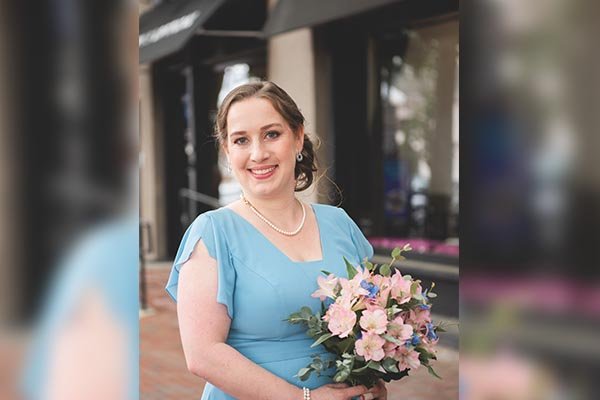
Denial And Acceptance: Take a moment to ground yourself every day.
Even if it’s something as simple as, the laundry is never ending. Write it down and then reframe it as, “I’m going to get part of the laundry done and then we’re going to move aside and move on with our lives.” Something that small moves you more than you think towards alignment and returning every day is so big to doing things.
When your laundry is that big, you’re carrying that laundry all day long. It has weights. It’s weighing you down in everything you do because that laundry is dirty. By saying that, “I’ll just deal with part of it and deal with the other part later.” I love it. Reframe, grounding and reframing. Write down a thought that’s bothering you and that’s rotating non-stop. Spiraling, writing it down and then reframing it. I want to ask you how people connect with you because you’re a coach now, so you have a business.
They can connect with me through Facebook, Instagram, and LinkedIn. I’m always happy to have people reach out to me through my email and be able to set up times to talk to chat. I’m always here when I can fit it. I have times and schedules fit in just to work with people.
Alexa, can you finish this sentence for me? It will always?
Freedom.
One word that describes you when you’re fully in flow.
That’s tough. I would say weirdly enough determined because when I’m in flow, I’m just pushing forward. I am not determined to get things done and keep moving.
One practice that instantly helps you return to alignment.
Breathing. It was a practice that felt weird for me at the beginning but now feels part of my everyday.
I might steal your daughters. I can have a sense of humor added to that because it came from a one year old. I like it. I’m going to try. One truth you wish everyone knew about learning, living, and leading into flow.
I wish everyone knew that it’s achievable. That it is more than just a grade or how much money you’re earning and things. It is a holistic experience and anyone can achieve that flow.
Living in flow is more than just a grade or how much money you’re earning. It is a holistic experience anyone can achieve.
It’s available to us. Anything is available to us. Thoughts are available to us. Use a piece of paper and a pen. Reframing is available to us. We don’t need to go somewhere else to get these things there. It’s so easy to do, but until the awareness is there and until we see that, we cannot help ourselves. That’s the problem. That’s where the blocks hold you like a hostage. Thank you so much for sharing your story and sharing about your son. You have a superstar. He expresses his soul print. We all have our soul print. That’s why we’re here. However, he doesn’t. He’ll show you guys and through that, we learn.
Thank you for having me.
Thank you so much.