

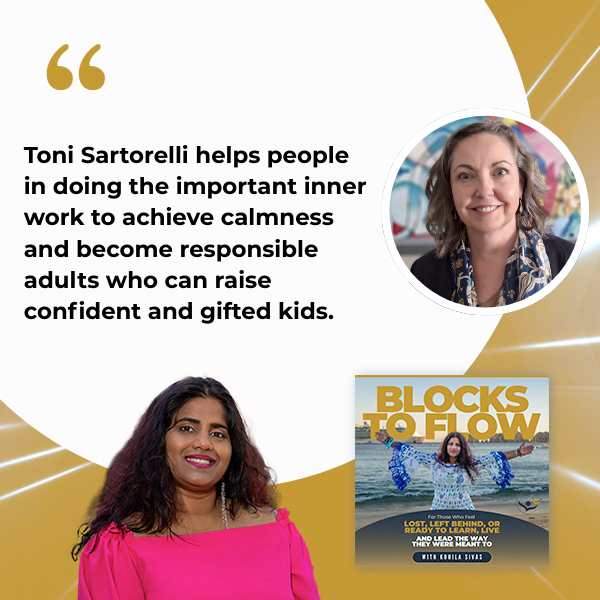
Children do not need perfection, but the presence of people who will not judge them and truly understand their needs. Toni Sartorelli, a Blocks to Flow coach, explains how calming your nervous system contributes greatly to raising confident kids and building peaceful homes. She joins Kohila Sivas to discuss how students blossomed, parents softened, and families finally felt hopeful again because someone chose connection over correction. Toni also opens up about the powerful practices that keep her in flow and allow her to perform at her best at all times.
—
Watch the episode here
Listen to the podcast here
The Calm Adult Changes Everything With Toni Sartorelli
Coach Toni reveals the nervous system truth behind confident kids and peaceful homes.
Welcome, Coach Toni. I am so excited to have this conversation with you.
Thank you for having me. I am very glad to be here with you.
In our conversation on the show, we always start with a breathing technique. As we all know, we are always in the past, thinking about the past, or worried about the future. We all forget to be here and now. We are here and now. What is your favorite breathing exercise to bring you to the here and now?
I really like to do the relaxation breathing where you breathe in for six, hold, and then breathe out slowly for eight.
How many do I have to hold? Just one count?
Four. Is it four? Hold four. In for six, hold for four. Count to eight.
Inhale for six, hold for four, and exhale eight. Let us do it. Can you lead us?
Sure. I am just going to count with my fingers, I guess. Here we go.
That is beautiful. Thank you.
Can you each remember to pause more often during the day and do that?
We all forget. It is so important. You feel even better doing that. I feel good. The thing is, I was having a hard time moving my finger and breathing. That was new for me. I do not know if the viewers will have that too, but it was hard. I started thinking too much.
It is hard. You have to give some kind of signal to the person that you are counting with the count. Those are the ones that I would use.
You had it right on it. You were very focused, but my brain was like, “Hold on a second.” If you cannot do it like me, it is okay. Just take a deep breath for the right. Inhale first six. It is not about the counting rate. It is more about that. Inhale, deep inhale, and hold. Do not let it out right away, and then exhale slowly and every bit of the air out of your lungs completely for eight. You really feel the rest, the peace at the end of it.
I have a mental visualization that I like to do as well. I want to imagine that I am breathing in really good air, and I see the color of bright sunny yellow. When I am breathing out, I imagine that all of the negativity in my body is going out. It is like a greasy, greyish, black, that air is coming out. Breathing in really good, beautiful light, and then breathing out all of the negativity.
Recognizing High Intelligence Level At A Young Age
I just did that. This feels very good, too. Thank you for sharing that. We are going to talk about blocks to flow. I want to ask you, growing up, what was one of the blocks you carried for so long?
I carried a block. There was something wrong with me. I had to hide my true self because my true self appeared odd to other people. It would get a negative reaction. Often an odd interaction. One of my earliest memories that brought some shame and some strangeness was that I knew how to play chess when I was five.
I can remember being introduced to people and having them say, “She knows how to play chess. Show them.” I was going to set up a chessboard, and someone was going to play with me, but it was never about setting up the chessboard, and almost as a spectacle. That’s one of the first things I learned how to hike.
I would set up the chessboard thinking I was going to play with someone, like the people who taught me to play, my family. For everyone else, I was just like a freak show. “This little girl knows how to play chess, and they would never play with me.” I can remember that it was one of the first things that I decided to put behind. That is one of the first things that I decided to hide about myself because of the reaction that it got.
As you were growing up, you saw differences among other people and yourself, even you did. That made you decide that I am just different?
Yeah.
Eventually, something must be wrong with me.
I spoke. I had a huge vocabulary at a really young age. I was interested in things. There were conversations on the playground. “That is not a word. What are you talking about? That did not happen. That is not true.” It was pretty clear that I had to learn to, we would call it masking, where you learn to just pass as everybody else and do not show things as much.
When did you recognize that to be a block?
Not that long ago, actually. I knew from a very early age that my intelligence level was higher. I knew that I was what we would call now gifted. I thought that made everything easier. Just even the word gifted, the assumption is, “You are gifted, everything must be really easy.” Things were not easy. You feel like a fraud when you encounter difficulty. Things come easily to you.
If you ever have to work for something, that just must not be for me. I did not realize that the block was related to that lifetime of masking. I did not realize that I had been doing that for a really long time until I started looking into working with neurodiverse children. Reading more about giftedness and going, “It is not all of these things that I saw were flaws of character, were actually just the way my brain functions and personal flaws or personal failings.”
Why Most Gifted Children Act In A Defiant Way
A lot of people, let us talk about this, because gifted students are viewed differently by the rest of the people.
Yes.
Many of us know, I do not, but many people think that gifted students know it all, that they are good at everything, and they are just perfect. I just like, “I do not even like them, because they make me look dumb.” If I start comparing, that is what I would feel. I did not know how to play chess at five. I did not know how to play the words.
Even the word, to stand up and say that you are a gifted person, is not a safe thing to say. You are seen as arrogant, or it comes with a lot of stereotypes and a lot of expectations. I also think that most children who are gifted are not identified as gifted. We rely on our education system mostly to recommend students for educational testing, which is where you would find out if they are gifted. If their parents are not interested in getting them tested, they could go all the way to adulthood and never know.
It is suspected that most people who are gifted remain undiagnosed. They are just everyday people who have this brain that works this way. They are not even seen in the classroom. Often, gifted students will show up to teachers as defiant because when a teacher asks them to do something, and they do not think it is a good idea, they will say, “Why should I have to do that?” They will argue with it, or they will not do it.
Gifted students often show up to teachers as defiant. When a teacher asks them to do something, they usually do not think it is a good idea.
I remember a gifted student, whom I had her on the first day of class. I did not know her, did not know she was gifted. The first day of class, we had to go to school. It was a warm day. She insisted on putting on her coat and her hat, and her mittens. I said, “No, we do not need to do that. We are just going from one door to the other door. We are just going to take a few steps outside.” She refused to take her coat off.
Immediately, on the first day of school, I am trying to build routines. No one is supposed to wear their coats inside the school. Here is a student who is going to war with me right away about her coat. It took a long time to get her to take her coat off. I escorted the rest of the students into the school. I turned around, and she had waited until everyone was out of the class, and she put her coat on and came into the school.
For a teacher who looked like defiance, it was what it looked like to me at the time, until I got to know her and her quirky sense of humour and her interest in things that other children were not interested in, and realized that she was a gifted student, undiagnosed. I could tell from the quirky sense of humour and the jokes that she made that were just well beyond her age.
Often, they will present as defiant children. They will present as unmotivated because sometimes, if they are not interested in something, they are not interested in working on it. Sometimes they are very interested in their own thoughts. One of the students that I taught had an IQ test, and it was so high, like a very tiny percent, profoundly gifted.
She was a straight C student. Most of the time, she would be daydreaming off into space because she was thinking about things, and class was boring. Teachers might have looked at that student and thought, “Maybe that student has ADD, not paying attention.” It was a student who was profoundly gifted. Straight Cs, very quiet, nice girl, but not interested in what was going on in class. It was very mundane and boring to her.
How Being A Blocks To Flow Coach Changed Toni
Now that you are a Blocks to Flow coach, using the Readiness OS, because we know that people are not on the acceleration rate. Everybody wants students and every one of us to perform, but we need to get to a state to perform. It is a state. Before we get to that state, there is a readiness phase that we all have to go through that is very personal to each one of us. It is not a standardized thing. It is very personal to each one of us because we are living things.
We are made out of different systems, subsystems. All these systems must be in alignment and activated so that we can enter this flow state to perform and achieve. Growing up as a child who had differences, and you labeled yourself during this time, what you are saying is that I am different. Did you call yourself like “I do not fit in, I am stupid,” or what did you start saying at that time?
I felt weird. I felt like other people did not like me.
They do not get me. They do not like me.
“They do not get me. I am a weird kid. I cannot seem to figure out how to get along in this world.” Even when I did, there was a time between elementary and junior high where I had a really close group of friends. They were girls who were quite popular. I remember as an adult going to visit one of them. I had shown up to work in Jasper, and she was working there. I had not seen her in years. At this time, I was full-on goth punk rock.
I had eyeliner up the side of my face and spiky hair, and this black and white check jacket on. She took one look at me. She said, “I am not surprised.” I said, “What do you mean?” She said, “We always hung out with you just because you were weird and funny.” There are moments like that that come out. It was just always feeling like an outsider, always feeling misunderstood. I still feel like that as an adult, a lot of times.
It is continuing. Now, as a Blocks to Flow coach, you understand how important it is to really spend time in this readiness phase to combat some of these things, because otherwise we carry them into our future, into our adulthood, then we go into personal development, and then there also we start masking the symptoms with hacks and strategies. It is a never-ending cycle. From coming from that point of view, from the Blocks to Flow point of view, how do you see yourself?
Probably one of the first things that a student who is gifted is going to need for that readiness. We talk about emotional safety first. The nervous system first that sense that it is safe to be who they are. They do not feel safe in some situations. They are often bullied. When we encounter something that is not what we expect, it might make our nervous system uncomfortable. We respond to that person in a way like they are a threat. They have triggered that part of our nervous system that is triggered by threat, because they just do not give the expected answer.
Do not behave in the right way, say things differently. In many cases, they are bullied. I do know that they are not recognized in their classrooms and not by the other students, and not by teachers very often. Teachers very often will pick students who have straight A’s and think that they are the ones who should go for gifted testing, but those are not necessarily the gifted kids. Those are kids who are very intelligent, but not to the same level that would qualify them as gifted.
Primarily, it is a sense of safety. I know that when I speak to another gifted person, we see each other right away. We see each other in the things that we are interested in, the way we speak. A lot of very simple social cues are different. We do not interact in the same way as neurotypical people. Our brains are working differently. Our social language is a little bit different. We recognize each other right away.
Having someone who is like you to talk to when you are a younger person to tell you that it is okay and help you understand that some of the things that are happening to you are not because it is your fault, it is the way your brain is working. First, it is that sense that it is safe to be who you are. Second, to be appreciated for who you are. To be seen as who you are, to know that it is safe to be that person, and to know that you are appreciated for being that person.
From there, there are often gifted people who will have asynchronous development. You may have a student who is five years old and knows very high-level mathematics, but is really lacking in social skills or maybe really lacking in language skills. One of the things that happens is this asynchronous development. For each child, the next step would be to take a look and see where things need to be worked on. Is there some executive functioning?
Is there a way that you can learn to self-regulate when you feel so incredibly frustrated? It is interesting because autistic children have very sensitive brains as well. That is the same with a gifted brain. It is just a very sensitive brain. Where an autistic student might be really disturbed by the feel of their clothing. A gifted student will feel that way about something unjust or unfair. It is extremely disturbing to witness that.
I know for me it was color. I have always been really sensitive to color, and going into a space where the colors are not right, or the clash, or they are too bright. That is always been that is always been one that affects me. For those children, each one of them is individual. Once you get past that basic nervous system at the very root, then you would go up and move into the other parts of the system, looking at what other people would call executive functioning ability to get by.
Ultimately, you want to get to that soul print so that they can see who they are as a gifted individual and truly what it means. They have an incredible amount to offer society, but can be very misunderstood. From my own experience, I do not know how a person who is not gifted thinks. I do not think a person who is not gifted can think how a gifted person thinks.
Get to the soul print of a gifted individual. They have an incredible amount to offer society.
Sometimes when a gifted person is doing their best and trying to be helpful, and because their brains work very quickly, see patterns really quickly, and instead of going from step one to step two to step three, their brains are going out in a spider web in all kinds of possibilities and very quickly being able to see connections and future possibilities and what is going to go wrong. One thing that I have really come up against is that people do not like that.
They do not like you to point out everything that is wrong with what they were thinking of in three seconds. It is their skills that can be taught when you understand how your brain works. It is a good thing in how your brain works, but it is not how everyone else’s brain works, and how to exist with other people that have brains that work differently, without all of the tension that can come when you do not have that awareness.
Gifted Children Should Never Be Defined By Labels
In our program, we do not place the label in front of the person. It exists. It gives us information, but it is the person I want to see. “I want to see Toni.” Emily is the person behind this, not the label that goes in front of them. That is why we say we do not look at any labels, because if I am able to look at you, when you were growing up, if I were a teacher, I would have looked at you as what Toni needs to grow and be with others.
If we all start looking from that perspective first, and the labels can come later. When you are accelerating, “I can give you strategies because you are faster than some other people might think.” There is this level that we have to match up to you because, otherwise, you will quickly be bored. We can add strategies and hacks, and tips on top of when you are in acceleration. Before acceleration, I really need to know who you are.
I expect that even though I say that I am a coach who will work with gifted children, I suspect that most of the children that I work with will not come with a diagnosis. They may even come with a different diagnosis. They may come with a different label because often it looks like ADHD or it looks like autism. A lot of the things that students need before they get to that acceleration point are the same, regardless of what the label is.
You grew up without knowing you were gifted. You just recognize that later.
I did know, but I had the same stereotypes as everyone else. I thought the same thing about gifted people as everyone else. I thought it was. There is Albert Einstein, and everything is going to be easy, and you are going to make some great contribution to the world or make some great discovery. That is not it at all.
A lot of gifted people grew up feeling like they failed, and their parents might not understand that either. With all of the students, I am seeing so many children who come with the same issues. Their nervous system is overwhelmed. They are in an environment that puts them in a state where they feel threatened. They feel like they are in survival mode. It does not matter what the diagnosis is. They all have the same need. You are very right. The diagnosis does not matter.
It does matter in the way we can understand a little bit of the strategy level, but it does not matter at the beginning stages of the readiness stage. It does not matter. Actually, what it does is it actually blinds everyone who is working with that person because we are not seeing the soul of that person.
It is a stereotype. The labels create stereotypes. I have been having, in the neurodivergent community, there is a controversy about whether gifted, autism, and ADHD are all in the same neurodiverse category. Some people do not put gifted in there because gifted is seen as a present. It is a good thing. Other neurodiversities are seen as a disability or a limitation. I do not think any of them are gifts or limitations. I think it is a brain that is working differently. The disability happens when you encounter an environment that is not set up for that type of brain.
Of the differences. It is an appreciation of the differences always.
It is different. It is no different if you are a redhead and sunburn very easily when you go in the sun, or if you are darker-skinned and you do not sunburn easily at all because you have more melanin in your skin. It is just, it is diversity. There is diversity in the way the mind works and as well as everything else. That is a good thing. A lot of gifted children have a lot to offer the world. It is not easy for them to get there with some of the ways that their brains work.

Nervous System: A lot of gifted children have a lot to offer the world, but it is not easy for them to get there with some of the ways their brains work.
Why Students Go Fight-Or-Flight Mode In Classrooms
It goes back to the way our school system was knowingly or unknowingly set up, because they thought at the time of setting it up that all humans would come into this classroom all ready to go in the state to learn, so we can just get them ready to be productive workers.
We are not widgets. We are all individuals.
We have our systems. I am a system. I am a living system. You are a living system. Just be trained to operate like a machine.
Our classrooms are sometimes set up to work like machines, where there is an expectation not only that everyone will arrive at school ready to learn, but that everyone can sit under fluorescent lights all day in a hard chair without a movement break for an hour or so. A lot of students, that is overwhelming.
Classrooms are sometimes set up to work like machines. But not everyone will arrive at school ready to learn and sit under fluorescent lights all day on a hard chair.
Some can do it, but not 90% of them can. Some might just look like they are sitting, but they are not even in the building. I used to be one of those students. I never created any disaster in the classroom, but my body was sitting there physically, but my brain was out in the world, out over there somewhere, wandering around. I was never focused in the classroom.
I have been thinking about this a lot lately, that the number of students who are really having difficulty being in school is. The number of students who cannot go to school, and the number of students who are having meltdowns in school. Teachers are seeing that it is really increasing. It is interesting to me because we notice the students whose response to survival is fight or flight.
If they argue with us, if they talk back, if they run away, they are going to get noticed. If their response is to freeze or if their response is to fawn and become the teacher’s pet and do everything, we do not think there is anything wrong. We do not notice that, but I wonder how many children are in classrooms with that stress reaction. No one thinks of it. We notice the ones that cause a disturbance.
I would say one-third nowadays. One third can be falling in that category, the one third would be the extreme behaviors that are happening, and the other one, frankly, away, and the other is trying to fight back, and the other ones are just quiet and taking it, but they are still suffering too.
We do not know it. I was really shocked when I started to have daily morning meetings in my classroom where we would spend 30 to 40 minutes every morning just doing a check-in, seeing how everybody was talking about things that had come up the previous day. Into the school year, they would start to share very personal things. They would open up and share things. It shocked me how many students are not feeling okay during the school day. It is astounding that they can sit and learn and behave with the feelings that they are carrying around with them. Some of them are astounding.
How Phones And Social Media Are Messing Up Kids’ Minds
We can even imagine that most of our students now have a phone. If they are in elementary above, they have phones. Imagine you are getting a text that if I get a text on my phone, someone says something rude or someone is upset, what will happen to my state of learning? It is gone. I am triggered, or I am now alert to something else that I did not have in mind. If you think about it, these kids who are middle school and older definitely have a phone, the majority of them.
If they are constantly on it, they are being triggered by all of the external noises that are happening around them. Some of them are very brutal. Some of them are bullying, and some of them are very brutal to each other because it is so easy to put whatever we want on the screen. We would not have said those things in person before. In our time, we never had cell phones. We would have to tell somebody something really mean. That takes another level. Now, put it on a screen. That is why, even adults, if you look at social media, how mean they are to each other.
We are not being a very good example for children, are we?
Yeah, some of the posts and some of the comments, some people are really mean to each other, that is because they would not do that in person. Somehow, on screen, we can do it because there is a disconnect between the screen and the real person being there. Seeing the real person, really upset, you would never say that. We do not really see that there is enough said because there is no person there. There is no support. That is happening a lot with our students. In the classroom, too. There are a lot of kids who are anxious, anxiety. It is just so much classroom. Even if I am a student who does not have anxiety, I can feel the anxiety of others around me, because it is an energy.
What really shocked me last year with children that are 9 and 10 years old was a belief that they had that if they were not perfect, no one was going to love them. This is the impact of seeing everyone on social media filtered and perfect. Beauty filters are everywhere. They look at themselves and think, I do not look like that. They know people are using filters, and they know they are using beauty filters. They had this deep-seated feeling that if they were not perfect, they were unlovable, and they were never going to be perfect. It is crazy.
Getting Your Child’s Label Is Only The Beginning
Now our work as a Wholistic NeuroGrowth Learning Success Coach using the Blocks to Flow method is to really give everyone what is missing in our education system in the personal development realm. What is missing is the readiness. If we do not know how to get this soul to be ready to flow, there is no performance. We are performing at that point, we are pressuring to perform, and pressuring to perform is not sustainable.
If you are not ready to perform and you are being pressured to perform, that is creating more stress, which makes you less ready to perform, and it can spiral down.
If students who are not ready to perform are pressured to do so, it will only create more stress.
It is a vicious cycle. We have been in it as teachers. I have been in it as a student. I have been in it, and you have been in it as well. Especially with you calling early on in your life, “I am different. I do not seem like I belong with anybody.” That adds even further. How many of our students are living this right now, holding on to even a label of already gifted, whether they received it or not, they are living with that as well. What is your advice for parents who are tuning in? If they do see that their child is different, what is the first step? Get the label?
No. The amount of time it takes to get a label for a child. There are a few things, like labels will help students get funding. They will get funding. They may be with that funding. It will be enough to get them some special help at a school. Unless there is a profound difference, it is very difficult to get any help at school. Also, the length of time that it takes. The longer you wait, as I said, the downward spiral compounds over time.
Something that starts as a simple, “I do not feel like I belong in kindergarten, and I do not feel like my kindergarten teacher likes me very much,” because that feeling can turn into very deeply carved patterns in a person’s brain, messages that they will carry for the rest of their life. It can also start increasing the tension, increasing what might be discomfort, which can turn into explosions in the classroom. That can lead to behavior problems and missing class being suspended. It can lead to families. I see a lot of families who do not know what to do.
They have got a diagnosis, but they are going to quit my job, and I am going to sell the house, and we are going to downsize, and I am going to homeschool because things are not good. They have let it go for so long. It is really important when you see that to get help sooner than later, to talk to the school, to talk to family and friends, if you can find a coach in your area that can help you, if there is someone at the school that can help.
It is really important to start early because huge changes can be made without having to make such a drastic decision “My child is overwhelmed at school, now I have to homeschool and change my whole life to do that.” It can start to affect families and relationships as well. My advice would be not to worry about a label. It does not matter. It is interesting when you look at different neurodiversities. If you look at the characteristics and struggles of gifted people and people with autism, and people with ADHD, there is a lot of overlap.
Do not worry about the label. IT could be anything. Find someone to help with what is causing the problem. Find someone who can help you uncover what is underneath the meltdown, what is underneath the explosion, what is underneath the depression, not wanting to go to school. Find someone who can help you gently uncover that. Whatever it is, slowly work on removing that for your child.
It will not be an issue to go to school, and you will not have to sell your house. We wait too long. Sometimes, a diagnosis at school, I have seen this many times, and in life, sometimes a diagnosis, yes, it is something that should get you help, but it can also be something that is an excuse for why things are not working. People can lower their expectations if a student has autism. “They have autism,” or “They have ADHD, so it is okay that they only got Cs on their record.” The stereotypes that come with it can cause a child to be treated differently and have lower expectations rather than help.
A lot of parents that I work with, as well, think that getting the label or getting some sort of remedy on top of all of the spirals that are happening is the end of everything. That is relief. Now I feel relief, but it is not really. After you get the label, is the beginning. It is like really the beginning of anything because you still have to figure out how your child is going to work.
No matter what the labels are going to tell you about what the child is going to be like, because they are still behind that label is a real person that has a soul that wants to express right now. It is the press, or something is going on that is not allowing them to express themselves yet. Until we remove the label, we cannot really look at the person. We have this filter in front of it. I cannot look through that filter at a person. I need to look at the person themselves.
That is right. A label does not describe a person. A person is a whole person. Every student that I have met who has autism is different. Every student that I have met who is gifted is different. I do not know every gifted person. I have met a few.
They are different. I have met two. They are different.
The diagnosis can give ideas of how you might help, but that might not be what that child needs for help.
When you get a label, what we are saying is do not think of it as a relief, think of it as, “Now I have a starting point to be more curious about the situation.” Here is someone saying, “This is what my child is, but who is my child?” That question remains to be answered. Who is this child? What is this child trying to express? As you said, what we think is a deficit in autism and ADHD, we think of it as something wrong, and in gifted, it is something not wrong. I love that when you said that, it is not that none of it is wrong. They just do things differently. Why can’t we look at it as their way of thinking?
What do they need to be comfortable and feel safe, and feel regulated? It might just be a small change in the environment.
To learn. What do they need? It is just a curiosity question. Again, I am just curious, what do you need from what you have? What do you need? Let me try to fit you into something we have already built.
That is right. It is interesting to me, too, what I am seeing now that it seems new to me is parents who have one diagnosis. That is not enough. They want because their child does not fit the exact diagnosis that they have been given. There is something else happening. They are looking for another diagnosis.
All parents want is relief.
The diagnosis does not bring relief. You have to work with the child. You have to work with the child to overcome what is holding them back. The diagnosis just says, “This is what is holding them back.” This whole range of things that could be happening, something in here might be difficult. It is good to get funding. It does provide some funding, and it can provide access to, in Canada, provides access to tax dollars for coaches like us, for example. I do not know if the length of time that you spend is worth it. It would be far better to do something first and then proceed with the diagnosis if necessary.
As a Blocks to Flow coach yourself now, you have a greater tool set and also this readiness OS. How do we take everyone from the awareness alignment to activation to really look at it through the system level? Our subsystem level is to unblock so that when we get to acceleration, if there is a label, you are able to help them implement some strategies that might work with somebody with autism or ADHD. Before that, there is no point in implementing any of those strategies or hacks because we have not identified what the soul needs yet. I am excited for what you do because you lived it.
I am still living it.
You yourself also are, past the point of calling yourself anything right, but looking at it as how my system needs to be in ready to perform. We all get through that. I am also learning to be. How do I get my systems ready so that I can be in the performance state, which, if I want to, if I do not, I do not have to. It is not a forced thing. It is always like, what do we need to learn, live, and lead? That is the question.
For me, it is very much like ADHD. I will become so interested in something. I will forget everything else that I was supposed to do that day. I will be reading and researching, and learning everything I can about an octopus because I found it interesting that morning.
If you think about it, if you can channel that, you know how important that skill is? Sometimes I do not have that skill. I might have an interest show up today about learn piano. I never would look up even if I were in ten years, I will be like, “I wish I could learn that.” I will not look it up because that is not how my brain works. You have this beautiful thing to look into something and go for it.
So do all of the other things that we call disabilities, all of the other disorders, whatever you want to call them. They all have a lot to offer the world as well because they look at things differently. Think of Temple Brandon. No one else thought about how to make a cow less stressed. She understood that. We need those different perspectives.
Unlearning The Idea Of A Hustle Culture
That is what makes the world beautiful. What was the hardest part for you to unlearn as you moved into more flow for yourself?
The hardest part to unlearn was the idea of a hustle culture. Thinking that success is going to come from working, pushing, learning more, learning more, and doing more. That was the hardest thing to let go of. The hardest thing to let go of was just to realize you have to take care of your body. You have to take care of your soul. Success that comes from working, being a workaholic, working all the time, is not healthy. That was one of the hardest things to let go of. To say to myself, “I have to rest. My brain needs to rest.” That is the big shift. To give myself permission to be healthy and not just keep driving forward.

Nervous System: You have to take care of your body and soul. Success cannot come from working all the time.
How much of that do we learn as we go through the school system to rest, find peace, take care of our souls, take care of our minds?
A little when I went to school. I went to school a long time ago, and we used to have nap breaks and things like that. More and more, it is becoming clear that kids are under an enormous amount of pressure in school. There is so much pressure.
More importantly, how would it have been for you to understand the importance of it? Not even if you do it like just understanding that my brain does need like, “This is what my soul and this body and this mind need, this is a great education.” Even if we do not do it, what about the education part of it?
It is so funny the way we think about teaching things to students. I know that in the grade that I taught, learning to make responsible choices was a learning outcome. Often, that learning outcome would be done with worksheets. Choose the responsible choice from these five sections. Very seldom would teachers in that grade actually allow nine-year-olds to make a choice and make an irresponsible one, and see what happens. It is the same thing. We study the body’s nutrition and what the body needs to be healthy. Do we actually live that in the classroom, or is it taught as a very academic something we learn in the brain, not something that we learn through experience and through our body?
If we learn about our hormones, this hormonal system, we would understand what it is, what all of this noise and distraction is doing to our body.What would it do to my nervous system, and what would it going to do to my emotional system? We would understand it because understanding is everything. When a boy, when a person understands they actually have a deeper level of implementation of that.
It only tells you, this is the way it is. You are going to put your phone away. I do not get it. You are making me do something. If you explain it to me, what is happening inside and the effect of it, I might listen more, I might lean in more because I might get curious more. Again, this is going back to really giving the why behind what we say is important as well, which is also missing in our system currently. That is why our Readiness OS is the missing link to education and personal development.
There is so much focus on looking at data and meeting standards, and finding the best curriculum and the best lesson. Sometimes the teachers who are sitting in those meetings are not at a state of readiness either. Everyone would put so much focus on that. If we were to take away all of that pressure to find the best lesson and find the best test and analyze the data and do all of that and take a step back and make sure that everybody in the class is at a state of readiness. We would see our scores go through the roof. We are constantly pushing for more, and that hurts the readiness. It is like we are despite our face. It is our focus is on the wrong thing. We should not be the missing link. We should be there. This should be in every school.
We will be there soon.
I hope so.
Toni’s Message To Her Younger Self
I believe so. Here is another question for you. If your younger self were to witness you now, if they were to see you now, what would they notice first?
They would notice that I have been pretty successful, not in the place that I wanted to be. They would be quite shocked at how easy it is for me to meet people, how easy it is for me to talk to people. They would also be really surprised at the relationships that I have in my life, the really strong support relationships that I have in my life, and that have been there for decades, and that stability and strength. She would also be just really shocked that I can walk into a room full of people and just start talking to them. It is not easy, but I can do it.
She will be shocked.
She would be shocked to see me here today.
Take A Pause To Reset Your Day
There you go. You are here. I am witnessing it. So amazing. People are, too. If you were to give one simple action our audience can take to get closer to alignment and the state of flow, what would you tell them?
I would tell them that it is important to take some time during the day for self-awareness. Take a space out of a point in your day where you stop and think about how you are feeling, how you are feeling emotionally, how you are feeling in your body. Just stop and take a body scan. Where do I feel tension? Where do I feel?
Turn that into time to relax your body, time to breathe, time to think about the things that have happened during the day, and let go of some things that have happened during the day. That simple, mindful practice, it sounds so ridiculous, but just to take a moment to sit and deliberately let everything go and just breathe and feel how you are in your body. We spend a lot of time going through the day, not even being aware of how stressed we are, how we feel.
We spend a lot of time throughout the day not being aware of how and what we feel. Taking a pause and a deep breath completely resets everything.
Taking that pause during the day to take a deep breath completely resets everything and changes the day. Working that in throughout the day is important, especially when I am walking into that room full of people, where I am going into that situation that I know is going to be tough. Taking that moment to breathe and be aware, and ground myself in everything. It changes everything.
I agree. We so take it for granted because it is so simple. We are giving something very simple right now. Some of you are probably watching, thinking that it is just so simple. Can you not give me something around here? It is the simple thing that we forgot. Those simple things that are missing right now are the simple things to step back and breathe.
Isn’t it lovely that it is something that you can do without having to have any equipment? You do not have to go anywhere. You can be anywhere and do it. It is very simple. You have everything you need in your own body to do it.
Even when you are part of toxic, even when you are part of toxic environment, you want to exit, just cleanse yourself. As you said, taking that sunshine of breath with the bright colors and releasing all that toxicity with that dark gray color. Changing even the breath into a color, like you started our conversation. That is amazing because then you are putting a visual to it, to that breathing, counting, and visual color is amazing. It is simple. You have it all the time. Try it. Thank you for sharing that.
The other one that works really well is getting out in nature. There are compounds in soil that do an amazing job of calming your body down.
Get In Touch With Toni
Just go for a walk, for sure. How can people connect with our coach, Toni, here? I am going to have all her information in the show note of this, so we are going to be able to connect you with her. She is on all social platforms, so LinkedIn, Facebook, and Instagram, so you can connect with her there as well.
It is important that if you have a gifted child, or you feel like they are gifted, or if they are showing some signs of giftedness, and you feel like there is something wrong? There is nothing wrong. They are just the way they are. They are born that way. There is help, and there are a lot of people who have gone through it the hard way who can help you, as Toni. I am so excited. Thank you for being here. Before you go, can you finish the sentence for me? Flow is?
Natural and easy once you are there.
I see it in you. It is peaceful. This conversation felt so peaceful and easy.
It is that feeling that you get when you are drawing or working in a colouring book or out working in your garden, and before you know it, five hours have passed. You have just been in a state of flow, just in the moment, doing what needs to be done, not thinking about anything else, and fully focused.
Thank you so much.
Thanks, Kohila. It was great to talk to you.
Thank you.