
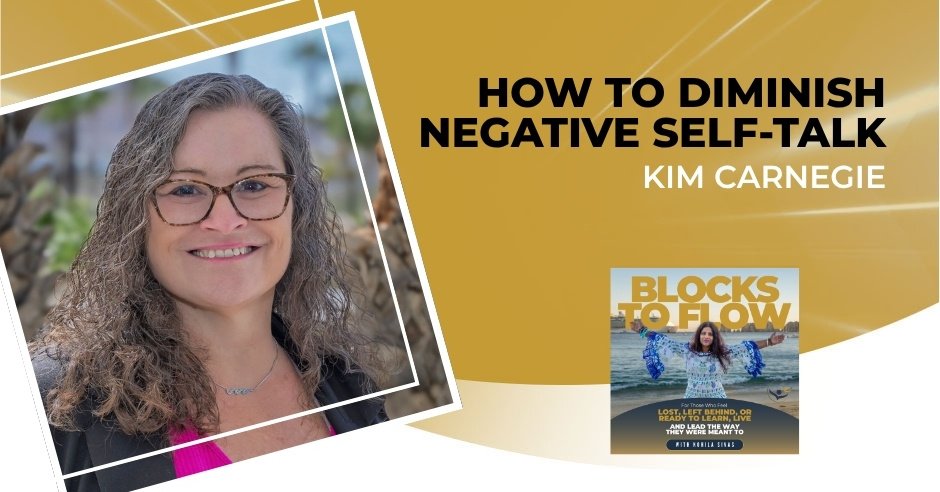
We all have inner critics, and sometimes they are so strong that they start to take over our lives. What is the right way to handle your negative self-talk and stop it from overwhelming you? Kohila Sivas sits down with Coach Kim Carnegie, Founder of Guiding Minds Learning Solutions, to share how she broke out of unhealthy patterns and a demanding work environment that suppressed her full potential. She explains how breathing practices and “talking to the brain” allowed her to diminish negative self-talk, get rid of her constant fight-or-flight mode, and escape the survival mindset. Kim also offers valuable advice for parents and learners on how to cultivate awareness and regulation for a more productive and fulfilling life.
—
Watch the episode here
Listen to the podcast here
How To Diminish Negative Self-Talk With Kim Carnegie
I have Coach Kim here. Welcome, Kim. How are you?
Thanks. I’m great. I’m happy to be here. I’m excited.
Very good. Kim, we always start this show with the breathing exercise, and I’d like to ask the people who are coming in to share with me, what do they do to breathe and relax and ground themselves? Do you have any exercises like that?
I absolutely do. I’m not sure if there’s a name for it, but the one that I found that is most helpful to ground me is to breathe in for 4, to breathe out for 6, and then to hold for 2 at the bottom.
Why don’t we do that? Can you lead us?
Absolutely. All right. Ready? Breathe in for 4, out for 6, hold for 2. Breathe in for 4, out for 6, hold for 2. In for 4, out for 6, hold for 2.
That’s amazing. Thank you so much.
That always grounds me.
How Kim Handled Her Blocks To Flow
Yes, grounding is so important and breathing is so important. I start this show every time with the breathing exercise because I think we all forget we can do it anywhere, anytime, whenever we want. It’s given to us. The breath is the only thing that’s available to us free, so we must take it. Thank you for being here. I do have a question for you, though, about Blocks to Flow. When you think about the phrase Blocks to Flow, what moment in your life comes to mind first?
When I think about Blocks to Flow, I think about how much I was in fight or flight survival mode my last year at work. When I was working 60 hours a week and I had a chronically ill daughter at home and I thought I was doing fine, but I started to have some physical issues. When I started this program, I got to know myself a little bit better and realized that I wasn’t fine at all, that I was really in survival mode and I wasn’t really even surviving. It was like I was constantly anxious and overwhelmed and really quick to anger. Learning the Blocks to Flow method and seeing what my life is like now versus how it was, that’s what comes to mind. It’s like I’m a whole different person.
Let’s go back to that period of time. What do you think was the block during that time? Why were you in that state of flight or fight mode? Were you surviving? What was the block?
I think the main block was my own self-talk. I was in a situation where my boss was challenging to work for and was very negative. I had a period in my life when I was younger when I had a lot of negative self-talk. It just started to I started to feed off of my own negative self-talk and I’m learning talk to your brain and starting to do that really helped me realize that my thoughts were sometimes creating the anxiety and the overwhelm.
Let’s go back to, you said you picked that up and carried it forward into your adulthood. It started in when you were younger. Take me back. Why did that start then? What happened then?
I was a little overweight when I was a kid, and I was a little bit different. I also strive to get the best grades in the class, and so I was picked on by my peers. I had a sibling who died when I was very young. In the household, there was always a little bit of discomfort as I was growing up. I just got into a space where I thought very negatively of myself. The voice that was coming I think was my own because it was never my parents who were saying negative things about me, but it just developed through experiences I had with my peers. That was a tough time.
How was it growing up with that voice?
It was difficult. I just believed everything that my thoughts told me. It never occurred to me to question my thoughts. I was never good enough. I was stupid, I was fat and I just believed all of that to be true when I was younger.
You carried that forward, and then when you got this boss who wasn’t really that nice to you, it triggered all of that.
It triggered everything right back up, absolutely. I felt that I couldn’t do right no matter what I did. It was wrong. Even though I was very confident in my work and I knew that I was very good at my job and had gotten a lot of positive feedback about being good at my job, it didn’t matter because that self-talk started coming back through her and I felt like I wasn’t doing the right thing. I wasn’t good enough.
It was almost like you went back to your elementary or high school with the bullies.
Absolutely. It was bullying behavior and it brought me right back to that space.
Becoming A Blocks To Flow Coach
It’s unfortunate that we have adults who grow up to be that way. It’s not that great. Now you’re a Blocks to Flow coach. Before you became who you are now, what was life like on the other side of flow?
When I didn’t have flow? My life was really fragmented and I just had a difficult period. I had trouble at work, being able to sustain attention and focus to tasks. I was constantly in that emotional space. I was dysregulated. I would fly off the handle at work. I made one of my secretaries cry. It was not good. At home, the same thing. I had a lot going on at home.
I would get frustrated when my daughter wouldn’t do chores around the house, but she’s chronically ill. There were days when all she could do was get downstairs and to the couch. It was just very fragmented and I had a lot to do, but then I would just throw my hands up and do nothing. I would get stuck in procrastination because I was just overwhelmed.
A lot was going on then. Tell me about flow. How are you in flow right now? You’re in flow?
I am absolutely in flow. I have a couple of routines that I do to try to keep me there. I have since retired from my position, and so that stressor has been removed. I have a routine that I do when I get up in the morning. I have a routine when I sit down at my desk and I find that I can easily be in flow and be productive for three and a half, four hours at a time, where I’ve not historically had any ability to sustain attention to tasks like that.
Everything just seems easy. My daughter is in treatment again and we’re taking that very well. We are just going with the flow, so to speak. Being able to provide her with her needs and make sure she’s taken care of and make sure that she takes care of herself on the days that she’s really struggling. It seems like a good balance of working for myself in terms of my business and my coaching, being able to take care of her and the house. It just seems to all work well. It’s like it clicks.
That’s what flow feels like.
It’s crazy because I’ve spent the vast majority of my adult life not in flow, and I didn’t know what I didn’t know.
When was your turning point that you decided that survival isn’t what you want and you want rhythm and flow back in your life? What was the turning point?
The turning point actually started when I began the coaching program here for Holistic Success Codes and actually some coaching from you. One of the things that was a turning point for my ability to leave work at work was a ritual that you had suggested, where at the end of my day, I go into the bathroom. I wash my hands and like wash away work. When I leave work, it stays.
That was one of the turning points for being able to come home in a healthier mindset so that I wasn’t bringing home the frustration and the anger and all of that. That was one of the key moments, for sure. As I retired and that the big stressor of work was removed, I realized that I still wasn’t in flow and recognized that I had to find some grounding exercises and some rituals and some structure to my day. Now it seems to flow really well.
That’s our society trading us to think that you work, you retire and you’ll have a happy life. Unfortunately, it doesn’t happen like that.
It didn’t happen like that.
It didn’t show up to you, did it?
No, as much as I was grateful to be in a space where I could retire, I was used to, for 35 years, being told what to do, when to do it, and deadlines. All of a sudden, here I am in retirement and it was like I had to relearn. I had to unlearn that routine of expecting somebody else to be telling me how to run my days and what to do and when to do it. I had to learn for myself what works for me as the boss.
That’s a struggle for many people. You can get lost, too. There you can get lost. Absolute retirement working all this way hard to gain it, but then you don’t know how to live because you never lived.
Yes. There’s a woman in my neighborhood that we take on walks with us when we walk the dogs, and she’s just so lost. She’s very negative and her life is terrible and it’s because she doesn’t have a routine and structure in her day. She’s left with her thoughts and her thoughts are negative.
I just heard about someone dying due to having so much alcohol because they were bored. They were retired. You can go into substances and things, too, because you just don’t know how to feel the day because it seems so empty.
That is the purpose of my coaching business. It keeps me busy, it keeps me alive, it keeps me passionate.
It’s beautiful. What part of your personal system that shifted first when you started into flow, when you got into flow, like internal systems? What was the system that shifted?
I guess my mind, my body, I started breathing and then that ritual of washing my hands. I had a 40-minute drive to and from work, and I started doing breathing exercises and actually saying positive affirmations on my way into work. Breathing exercises and listening to music on my way home to just debrief, leave the day behind.
I would say my body, my pulse was raised, my blood pressure was crazy out of control. I had to go on medication. When I started some of these rituals and I really realized that my thoughts do control some of my body’s reactions, and I was able to get that under control, my body settled down, and then that helped.
Getting Aware Of And Diminishing Negative Self-Talks
Let’s talk about talking to your brain because you had a lot of negative talks. That was what was spiraling your negativity in the work and all of that. How did that shift after learning about flow and talking to your brain? How did that shift?
I named my brain Ms. Thang and I would have to talk to her. Interestingly enough, sometimes she needed to be yelled at. Sometimes I needed to be gentle with her, depending on what those thoughts were. I literally would be like, “All right, Ms. Thang, you’ve done enough. I need to do this. None of this negative.” It literally was a conversation that I started having with myself that happens on a regular basis to keep those voices at bay.
They don’t ever disappear, but they come fewer and farther between when you have positive affirmations. One of the things I do is journal and I journal what I’m grateful for, and I journal a positive affirmation every day. When you start building those networks, those neural networks of the positive, the negative aren’t as strong.
Negative thoughts do not ever disappear, but they come fewer and farther between when you have positive affirmations.
They start diminishing. You learn to catch them, too. When they come, you’re like, “I hear you. I remember you. I know what you’re going to tell me. I already know what you’re going to tell me because I’ve heard it. I heard it many times, so I know why you’re coming in right now.” Those thoughts don’t go away. That’s really important. It doesn’t go away. It just gets diminished. You’re able to catch it like this.
You go, “I get it. I know what you’re going to do.” That was the awareness. Becoming aware of how much negativity is going on. It was fueled by the environment and the situation at home, but it started when you were young. You carried it forward. Now, finally, you’re able to be in flow. We should have had that all along, all of us. We suffer and then it was always within us, but we were never taught to find it.
When I learned the Blocks to Flow method, I’m like, “Where was this when I was a middle schooler, a teenager, and where was it for my kids as well?”
Not Everything In Life Can Be Fixed
What was the hardest pattern to break or a belief to unlearn when you moved through from blocks to flow?
I’m still working on it, but my number one thing that I continue to work on to try to unlearn is that I’m a fixer and everything needs to be fixed and I need to be the one to do it. I have lived my life proudly declaring that I’m a caretaker and I’m a fixer. There are many things in life that just can’t be fixed. You miss paying a bill, you can fix that by paying the bill, but humans can’t be fixed.
Trying to fix, I can’t fix my daughter’s illness and that was a struggle for me. Changing my mindset and realizing that her illness isn’t to be fixed, it’s to be managed and it’s to find the workarounds so that she can have a productive and healthy life. It’s about fixing. I continue to struggle because it’s my go-to. For 55 or 56 years, I’ve prided myself on being a fixer, but not everything in life should be fixed.
Where did that come from, if we go back?
I think it’s generational because my mom was a fixer and my brother is a fixer. Both my children are fixers. It’s almost generational. There’s something about us that we see someone who is struggling and we naturally just gravitate to those who are struggling to try to relieve their suffering.
Getting Out Of The Flight-Or-Fight Mode
That has made you into a beautiful person and a beautiful coach. That’s where your compassion comes in. It actually gives you so much quality from that, but you cannot do it in certain situations where you can apply yourself and make feel bad about it that I could help. There are some things. That comes from parents. Some of them are passed to us. How does alignment feel in your body now compared to when you were in that survival mode?
It’s like night and day. As I said, I was in high stress. I needed meds for my blood pressure. I’m actually off one of my blood pressure meds and we’re working my way off the other one. Being in this environment and being in flow and alignment has adjusted my body to the point where sometimes my blood pressure goes too low because of the medication, because I’m feeling aligned in my systems and safe in my emotions. It’s like night and day because I was just constantly in this state of heightened ready to fight and now, I’m just flowing along.
Let’s say somebody reading is in a situation like yourself where it’s a bully at a work that sometimes it’s somebody who has a higher position, sometimes it’s not. It’s just somebody that you co-work with. In a situation like that, you can’t escape because you need money? You need to go to work, you need to find another job, which is sometimes not possible, so you just put up with it.
You say, “It’s another year, another day, another month. I’ll handle it.” Your body starts signaling you all over the place. All of this is happening and then we just keep going because of course we need the money. We can’t just say, “I’m quitting.” It’s not possible. We need to pay bills. What one ritual they can do right now in that environment to help them?
I would say tune into your body. Take a moment, be still, see where you’re holding tension. See where you have discomfort. Do some breathing because, like you said earlier, you can take it anywhere. You can go into the bathroom and shut the door and you can breathe. You can do a body scan and you can breathe. You, generally speaking, with that breath comes a feeling of calm. You can, in that moment, shift your thought.
Tune in to your body, take a moment, and be still to know where you are holding tension.
Talk to your brain. Also, notice if it’s a trigger from your past that this person or this environment is triggering, because it could be that it’s not necessarily the person. Maybe you already had an experience that you never dealt with and that person is triggering it. Now you have a conflict with that person and you don’t have to react to them.
By becoming aware of that, you are going to have less conflict with them. Now you’re going to start in internally researching. Where did I get it? How did I get it? How can I deal with this person in a different way? Awareness is so powerful because sometimes when we’re in a situation like that, we’re always projecting outward. In a place like that, you need to go inward.
You need to find strength from inside to say, “Your comments don’t bother me. What you think is none of my business. Am I doing what I need to do? Yes. Do you have a problem with that? Let’s talk about it. Where’s the exact problem?” You get this clarity and this confidence because you are not triggered. When you’re triggered with your old blocks, you’re going to be reactive. Everybody’s reactive. I’m reactive too when I get absolutely triggered.
That’s why I always say go inward and then that ritual you did before you left the school, so if you have a place where you feel like at the end of the day, I can go into my environment home or to my children or to my wife or a husband or partner, and if you want to, wash your hands, even change your clothes. Just let it go.
When you initially told me that, I was like, “Okay, I’ll do it, but that’s ridiculous. How could that possibly help?” It actually does. I would wash my hands, I’m washing away the day and it was crazy. How could such a simple routine impact your mindset? It does.
The water has properties to cleanse and calm us. That’s why when you take shower on your back and stuff, it’s actually soothing and calming for your nervous system so that if you were triggered in that environment already by washing and taking a shower even at home, it will actually definitely shift you. If you are younger self could witness, what would they notice first?
They would notice the calm that exudes in me and my space because I’ve always been a pretty amped up individual and I can get amped up when I’m passionate and when I’m doing things I love, but just not being in that fight or flight. It’s crazy that I spent the vast majority of my life in fight or flight as I look back. I think my younger self would be like, “How do I do that? How do I get there and sooner?”
Take A Breath And Talk To Your Brain
For our readers, give them one simple action that they could take to get themselves closer to their alignment and into flow. What would you offer them?
It’s a toss-up between breathing and body scan and talk to your brain. One of my coaching clients really struggles with negative thought processes and talk to your brain is really the thing that has been helping because it does bring that awareness, as you mentioned. When he comes back to his coaching sessions the next week, he’s like, “I had this thought and I was aware that that’s what it was. It was just a thought and it wasn’t real.” I think probably talk to your brain. Just name your brain and talk to it. Recognize those thoughts that aren’t real. They’re based on something from your past.
Let’s go into one of them so we can model it, how this is done, because it seems like, “Talk to my brain. How do I do that?” If you’ve never done it, it’s a question like, “How do I do it?” When you were in that work environment, because we’re talking about that right now, that was your block. What was something that you negatively told yourself repeatedly in that environment before you knew about it?
I think what I was saying is you’re not good enough. You’re not getting all your work done. You have to be faster. You have to be better. It was all related to not being a good performer.
Was that coming from the administrator or somebody you were working with?
Yes, I was getting some feedback for that. One of the challenges that most work, I think a lot of people can relate to this, is the better you are at your job, the more you end up with more to do.
Yes. You’re so efficient. Let me give you more. They can only push the efficient system. If you go push the inefficient system, it’s not going to go anywhere. If you’re efficient, they add more.
You get more work. You get other people’s work and then
Go faster.
It got to a point where I don’t know that my job was a doable job and now that I know there’s a new person in it, they’ve had to take a number of the responsibilities away and give them to somebody else. I think I was put in a situation where it wasn’t a doable thing, and yet me, being who I am, I have to do good at my job and so I was trying.
You’re a fixer.
Yes, it’s because I’m a fixer. I think there was potentially a little bit of truth to the fact that I wasn’t but it spiraled those thought processes back from my childhood that you’re not good enough.
Have you ever thought about that you were doing so much, they just adding more? Did that come at that time or is that something you had it after?
It’s hindsight, especially when I heard that the person who replaced me doesn’t have to do all of the things I had to do. It wasn’t in the moment. I didn’t really know it in the moment.
You set yourself so high and then you achieved that, but you didn’t even recognize you’re achieving then the other people did who are inferior to you. They did. They’re like, “This is a really efficient person.” You keep pushing your bar up because you know you are a fixer, like, “I’ve got to fix all of the rest of the stuff and then the rest of the stuff.” Time came, you’re like, “This is too much. I don’t think I can keep up.” You are already working at your full capacity. Over capacity now. At that time, that real block was that your self-worth was tied to, “I need to keep fixing to be the person that Kim is.” They noticed it. They figured it out. They figured out who you are and they played it.
It’s pretty cool. What could we talk at that moment is sometimes, that’s why I say awareness is first you got to first be aware that this is the game we’re playing, then administrators or whoever. I’m a fixer. I love to raise my bar up so I can keep going. I can over my capacity, exceed my capacity, and they know that they’re playing this game. When we know that we can say, “Now what’s my game?” That’s how you start talking to your brain. Detachment from self-worth is equal to my output. It is not equal to my output. It doesn’t matter how much I output, I’m still Kim. I’m still a healer. It comes from our education system where performance was reported. Everything was required. Everything perfect was perfect.
Yes, and that is absolutely how I was. I was the student who strived to get the best grade in the class. Now here I am at work and I’m striving to be the best worker and get the most done.
That turns into perfectionism, too, at the end of the day. What is a conversation a person can have right now? First is to be aware why is that happening? When you’re aware, you can then say, “I am associating this to this, so let me talk to my brain calmly, like, ‘I’m not doing this. We’re not doing that.’” Whatever the brain is telling you. Whatever it is, it depends on how it comes out because the block has to be discovered, when it started, where it started, and then from there, you can come back. The first is awareness. That’s the number one thing. You can start losing. Whatever your brain is saying too many times in a day is a good place to start.
I used to say I’m stupid. Immediately, for anything, if somebody says, “Can you do this,” I’ll be like, “No, I don’t because I think I’m stupid.” It was so easy to say it. I said it so many times in my head and out loud, it became like a little phrase like, “Yeah, no, I don’t think so. No, I’m stupid. I don’t think so.” It took me not until in my 30s, I used that so much. It was constant, without thinking it was dropping.
Whatever you’re thinking, whatever your word choices are, I would look into that and that will help you to become aware. The first step is to be aware and then start rephrasing into what you want to happen. That’s what people say about manifesting. The gratitude and manifesting is whatever you think is whatever you’re going to receive. If you keep thinking negatively, negative is going to come to you. If you think start thinking positively, the workplace might even change. Maybe the person might even leave. You never know. They might find another place. You left, though, before they left.
Yes. I left first, but all of the people who were left are safe now.
Get In Touch With Coach Kim
Thank you for sharing, Kim. If people want to connect with you, I know you offer coaching for adults, students. How can they connect with you?
I have a website. They can always go to my website. It’s GuidingMindsLearningSolutions.com. I’m also on Facebook, Instagram, and LinkedIn. They can connect with me in any of those ways.
Answering Rapid-Fire Questions And Episode Wrap-Up
Perfect. Finish this sentence for me, Kim. Flow is?
Flow is the harmony between your body and your mind and your environment.
Flow is the harmony between your body, mind, and environment.
Harmony. Love it. Beautiful. Thank you. One word that describes you when you are in full flow.
Productive.
Another word jumped out as you took that deep breath. I think grounding. It just popped up. Productivity is good because you said you can now spend five hours in flow and get things done. That 5 hours don’t feel like 5 hours.
It doesn’t.
It goes so fast because you’re in flow. One practice that instantly helps you when you return to alignment.
I think journaling.
How long should a person do that? Half hour, ten minutes, or just whatever you feel?
I think it depends on the person. I’m not a free-flowing journaler, so I have a set of questions or prompts. I have my, I am grateful for, my daily affirmation, my what would make today great, what things could happen that would make my day great, and then my daily intention, like intention and my settings. At the end of the day, I journal that back and reflect on the day, so that helps.
That’s something you have to sometimes come up with. Perfect prompts. What’s one truth you wish everyone knew about learning, living and leading in flow?
Know your nervous system because if it’s dysregulated, you can’t find flow.
How do I know it’s dysregulated?
That’s where the body scan comes in. You have to check and see what’s going on in your body. Listen to your brain and do grounding practices to get yourself in regulation.
How would I know, though? I would know by how I’m reacting with people. How am I interacting? If my nervous system is off, I’m going to be off in my environment. Interactions with my environments are going to be off, and then my sleep will be off, my sleep is going to be affected, my eating will be affected. My hormones are all over the place, which is what happened to me. You will know. You’ll have signs. You’re going to feel it.
Other people will also notice around you that you’re fatigued, you’re agitated, you’re just not patient with yourself, even. Forget the other people, but even with yourself. There’s always this anxiety that’s living, like there’s something that you can’t rest. That’s what’s happening to many people right now, this unrooted feeling like, “I’m floating. There’s never a feeling like I can settle.”
It’s like you’re waiting for the next thing.
What’s your biggest evolution with becoming a Blocks to Flow coach?
I think it’s in listening and seeing to the body and to the signals that another person is giving off. Not necessarily their words, but the signals. I have a little guy that I’m coaching now and he has a language disorder and so speech is not his primary way of communication. It’s behavior. It’s through his body language and that kind of thing. Through the process with him, I have learned that there’s so much communication going on through body language and facial expressions. I never would’ve spent that much time paying attention to other people before Blocks to Flow.
We miss so much communication from other people. As a teacher and a special educator yourself now, you look at coaching from a different angle. It’s not teaching, it’s not tutoring, it’s a different angle. Can you share about that?
Yeah, so coaching for me now is all about the student becoming aware. Becoming aware of their systems, becoming aware of their nervous system, becoming aware of whether they’re regulated or not. The learning naturally happens. When I’m coaching, I’m not spending time teaching content. I’m spending time regulating the body, taking breaths.
My little guy went from my first few sessions being not even 30 minutes to being able to sustain attention to task for 45 to 50 and even 60 minutes. In order to be functional in school, being able to sustain attention for that length of time is going to do wonders for his ability to learn. My job as a coach isn’t necessarily to teach him the content so much as it’s to get his body learning ready so that then the learning can happen.
You’re doing all the prerequisites for his learning. Thank you so much. Is there anything you want to tell the readers?
No, I think that’s everything. I think you asked some really great questions and you got to know me.
If you could give every parent and learner one message, what would it be?
I think it would be to listen to your body and breathe because I know many times, parents and kids get into that power struggle. A dysregulated parent can never regulate a child. We have to pay attention to our own space and our own selves.
A dysregulated parent can never regulate a child. We have to pay attention to our own space and our own selves.
Absolutely. Thank you, Kim.
Thank you. I appreciate it.
Readers, have a blessed day. Keep breathing, keep grounding yourself and talk to your brain. Your brain actually works. First, awareness, then talk to your brain.