
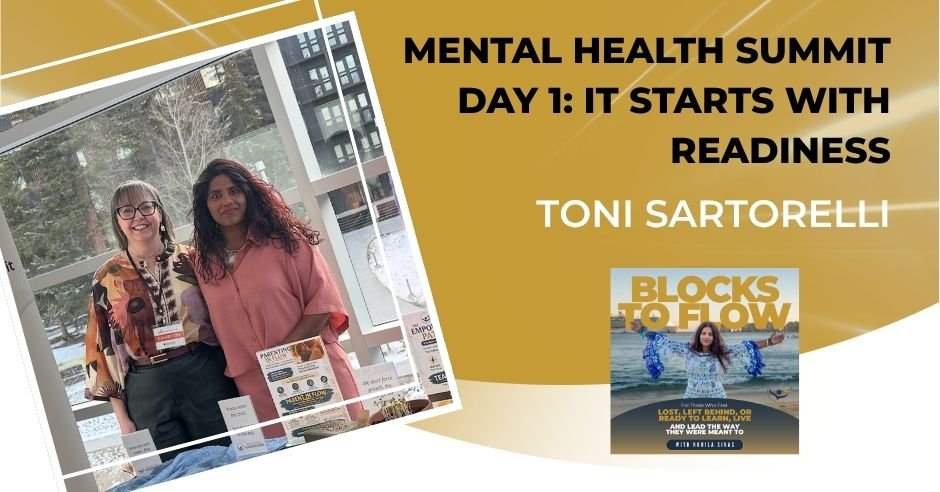
Day 1 at the Mental Health Summit opened a different conversation: What if the problem isn’t behavior, motivation, or performance—but readiness?
Before we fix, push, or label, we have to understand the human system underneath it all. This is where the shift begins—from managing symptoms to restoring the foundation.
Because nothing works until the system is ready.
---
Watch the episode here
Listen to the podcast here
Mental Health Summit Day 1: It Starts with Readiness With Toni Sartorelli
I am so excited to be here with Toni.
I'm so excited to be here too. This has been this is a great place to be right now.
Yes, so where are we?
In Banff, Alberta. We’re at the Mental Health and Education Summit, which is an annual summit put on by the Werklund School of Education in Calgary.
Yes, it’s been beautiful. Day 1, that’s our booth back there. We have a lot of things on our table, we’re going to explain a little bit later, but we want to bring ourselves now in here. How about yourself? I know we are here. We have been present so much. It’s been a lot of people here, so about 350 people or so.
About 350 to 400 people came and there's about 25 presenters over the two days.
Worries About Being A First-Time Exhibitor At The Mental Health Summit
Yes, because we have a booth, we haven’t been going to a lot of those, but we had a lot of visitors come up to us. We’re excited to share that with you, but I want to bring you here and now just like every other day, so we do have to talk about our past. Have you been thinking about your past?
I was, before we came here, I was worried about a lot of things that because this is a first time for me and so I was worried about what would happen. Most of all I was just the usual worry, "What if we go and we do something wrong or we make a mistake or we look foolish or out of place?"
Did anything from the past come?
Yeah, I think some things from the past come. I'm usually here at these kinds of summits as a participant. This is my first time coming and being a vendor or exhibitor. Sometimes it would be really nice to come and be a speaker, but this is my first time on the other side of the table.
Yeah, so what did your brain say to you when before we came what was the conversation like? "You’re going to screw up the conversation, you better not talk to this person."
O yeah, "I’ll let Kohila talk for the first two hours to everybody and I’ll listen to what she says and then I’ll do just what Kohila does and it will be fine." that's not what you did. You left me all alone and sad and did your work and I talked to everybody. It took a couple of people to feel comfortable but that was all, it was fine.
Yeah, I didn’t need to micromanage you standing there. Nobody needs that. You give freedom and then a person will just talk because it’s natural. In these spaces everyone wants to talk. That’s the thing. Everybody has that same feeling. We always think it’s me that’s feeling that way, but it’s everybody probably had that same past conversation about, "Past event, I did this. I didn’t do this right, I should have introduced myself like this, I should have said this, I don’t know why I didn’t think of this," we do that. After we finish a conversation in events like this, "Why didn't I think of this? Why didn't I do that?"
Yeah, "Why didn't I think of that? Why didn't I do that?"
We have a lot of people in and out, so we’ll just quiet for a sec. It’s a big building so the sound echoes, but you can hear the excitement in the room.
The Shift From Talking To Making Visitors Feel Heard
You can hear the excitement in the room. Do you know what really shifted for me yesterday, though? When I was at home thinking about coming here I thought, "I have to stand behind this booth and I have to talk to people all day." something shifted in my mind and I realized, "I have to stand behind this booth and I need to make sure that the people who come to this booth feel heard all day." That made it so much easier.
Mental Health Summit: When I was at home thinking about coming here I thought, "I have to stand behind this booth and I have to talk to people all day." Something shifted in my mind and I realized, "I have to stand behind this booth and I need to make sure that the people who come to this booth feel heard all day." That made it so much easier.
Yes, that was forced, and also that was a force, and then you got into flow. That second part sounded very much flow language.
I did get into flow. I came up with a really good question, I just asked everyone, "What brought you to Banff today?" and that was a really easy way to talk about why they were here and find out what it was that they were looking for.
When we go to these events, our past experiences do come up and they come up like right before the night before you show up here. Yesterday I was like, "Who am I going to talk to? Who should I first meet? How should I plan this out? What’s my action plan?"
"Did I make any spelling mistakes on the banner?"
H yeah, that one I was checking and I had to ask Toni, "Please read every single word over there to make sure I did not spell something wrong," even though I checked it already twenty times or more.
Yes, and just making a display for a space that you don't know what it looks like.
Yeah, beautifully it came together. I love it. The past conversation is normal. It’s normal. We both had it, I had it too, I was planning. I looked up all the speakers, I planned some because that’s how you keep your anxiety down, and instead of being in the past thinking about how I screwed up last time, what I did is I looked up some of the people and I networked already online with some of them and said, "We have a beautiful table, come see us upstairs."
That was nice instead of me being in the past beating myself about, "Remember the last event you went, you screwed up a sentence and that was so embarrassing?” Don't do that again. That would be the conversations. Our brain likes to beat us up. It’s like a boxing match, I find it like it’s a boxing match, it just keeps pushing you and pushing. Instead of I could be here in this moment and I could be thinking about how what I did, going to LinkedIn and connecting with people before I came here, that was a good thing to do instead of beating myself up.
I couldn't do any of that because I was driving on the highway in a snowstorm, so I could only be in the moment.
You saw so many accidents, so yeah, you have to. That’s another way to be in the moment. That’s why I love driving, I think.
Yeah, I wonder if that's why some people like sports.
I can also go into thinking past though, because driving is not something I consciously do, do you?
No, but I do in a snowstorm.
Yes, do not be passive. Be active in the snowstorm.
Not the time to just drive on autopilot.
Whenever I start driving, my brain’s just like it’s like floating. I don’t even know where I am. It’s so peaceful. That’s why I love driving.
That's how my family used to regulate me when I was a child. I still love it. I still love to sit in the passenger seat and go for a drive at night.
Yes, it’s beautiful. Yes, so bringing ourselves now and here is important. What can we do with the past? We can only pick up the lessons. That’s the only thing available. Other than that, beating and having a boxing match with your brain is useless because it’s spending all the energy that I could spend now and here. Another thing that happened probably to you, but to me, is about the future like, "What are we going to do with all the people we talk here? How are we going to network ongoing? Who am I going to partner up with or do things with or connect with or ask them to be on this or that?" the future planning. What that does is when you’re in an event like this, it takes you out of now and here.
All of that worry, I know right before we presented, I was lying in bed, we'd set up the table, and I was lying in bed trying to go to sleep and my mind was racing. I realized, "Wait a minute, you're at the Banff Centre at the Mental Health Summit as an exhibitor," and I just started smiling. Once I realized where I was and what I was doing, I stopped worrying about the future because this is something that I’ve wanted to do for a long time. Relish the present. It’s so easy that as soon as you get somewhere you think you need to go to the next level and you worry about that and it just taking that minute before I went to sleep to go, "Wait," and a big smile came over my face and I think that’s probably when I fell asleep.
Yes. Worrying about the future, projecting the past have you ever done that? I do that. We all do that. Like thinking through the past, "Remember last time you did this in at this event, so this time you better not do this,” and then, "Here are things you should do next time," but what about right now? We always talk about this time, last time, next time.
I was absolutely certain that when I retired I was not going to want to be a substitute teacher. I was adamant, "I'm not going to be a substitute teacher." I’ve gone back to be a substitute teacher. What I thought being a substitute teacher was was when I first graduated from university and I was trying to get a contract and I didn't know what to do and didn't know how to manage classroom behavior. I'm a fantastic sub now and I'm really enjoying it, especially with the coach training. It's so easy to go into a classroom and if the classroom is behaving the way they do when a substitute teacher is in the class, that only lasts for about an hour.
You bring them now and here.
I address it, I bring them now and here, I connect with them, and then everything flows.
Your energy is different. That reflects back to them.
I'm not striving anymore. I'm just enjoying being able to be there with them.
Using The Pulse Connection Technique For Emotional Regulation
Yes, so being here and now is the only place we can learn for every one of us, and this is the only place we can live and lead ourselves and others. Except we tend to go everywhere else. That’s why this moment is so important, there’s no other moment in our life that’s important than this one right here.Another thing that we want to do to bring ourselves is breathing. We’ve always done breathing so I want today model something different because breathing I do this every day so I’ve shown them the breathing technique. What about the pulse?
Borrowing each other’s energy.
Energy, so that yourself or your child or your student even, and if you can’t touch your student or somebody else and they don’t want to be touched, they can do it to themselves like this, back onto their own nervous system, the pulse, so that they can calm. I always sit like this. If I’m in meetings, I sit like this.
I'm going to try that.
If you do this, it’s a full circuit.
Good idea. I'm going to try that. Next time I'm nervous, I'm going to try that.
Before I speak or if I’m thinking or if I’m in a room that’s new for me, this is a good posture to be at.
It’s comforting, but if you could do with another person, then you find their pulse. Let’s go here. She would find mine and I would find her. We would find each other’s pulse and then if we quiet down, we can really sync into each other’s rhythm. Eventually, we would both start moving and breathing and syncing into the same rhythm and what that creates, it’s a calm effect, just like the breathing. It’s very beautiful to use it anytime. We think we have to talk to our kids. Sometimes when we’re so excited and we’re in an argument or we’re in a situation, talking is the worst thing you can do.
Singing, however, is better. When you sing together, they've noticed that when they put people together to sing and they measure their brainwaves, the people that are singing together, their brainwaves synchronize. I think preschool teachers understand that. Some of the best preschool teachers I’ve ever seen have a song for every transition and all the children sing along, and I think that's just a way they were regulating their class.
When people sing together and researchers measure their brainwaves, they find that the singers’ brainwaves begin to synchronize.
Yeah, it’s beautiful. As you can see, I’m already calm, I don’t know about you.
I am too.
It just works every single time. We did this in our Parenting in Flow workshops and you could see the whole room just drops.
Everyone’s shoulders drops.
The energy is just like calm, peace. If you ever in a situation, you could do it just by yourself, do it with another person, with your child, with your student, if they’re okay with it, always ask. If it’s someone you don’t know, you just ask, you don't just go take their hand.
I tried this in one of the classrooms that I was in, the first sub job that I had, the first thing a student said to me when I walked in the class was, "Are you our sub? Thank god you're not Mister." I guess they had a substitute teacher they were having difficulty because substitutes would come for a day and then not come back. I needed to get them calm and I presented this like a science experiment, "This is a really interesting thing."
Yeah, because it’s a circuit.
Yeah, and so we talked about it that way, and I didn't say it was going to regulate them, I just said, "Do you want to try something really interesting?" and they did it. Some students, the "ick" of touching another student is not regulating and so I just told them they could touch their own hands. You know the whole class came right down. Kohila, the assistant principal, came in to see me and she said she’d never seen the class so calm with a substitute.
Why did you say yes to this event?
I said yes to this event because I knew there were going to be a lot of people from all over the world that are interested enough in mental health in schools to travel all over to Banff to buy a ticket and to come here. I wanted to meet them and I wanted to hear what they had to say. That was why I wanted to come here. You wanted to exhibit, which I think was brilliant.
Yeah, I want to speak, but I was late. I never give up. I sent them an email said, "What’s available?" They said, "We have vendors, exhibitors." I’m like, "Sure, there’s the message," right? So it it doesn’t matter how you come here. If you decide in life, you will be attendant.
I know, and I asked you to come earlier and you said, "No," and I was like, "She needs to come here." I said again, "I'm going," I didn't even ask you to come, she said, "I'm coming too."
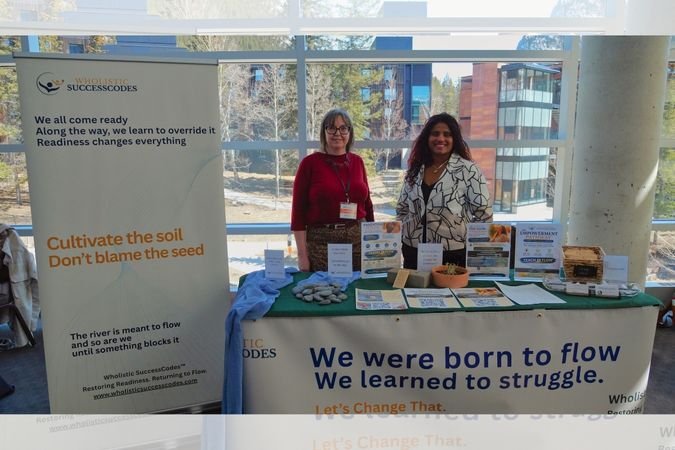
It was the right time, so I’m glad I mentioned it a second time. Yes, so we want to do we want to read the banners? The first one, do you want to read it, Toni?The top one.
It says, "We all come ready, but along the way we learn to override it. Readiness changes everything."
When we’re not ready, for example, my story, we just talked.When you asked me, I wasn’t ready.
You weren't ready.
When I’m ready, I was ready to flow and I flew here.
I know, and when I first asked, I'm like, "Why isn't she jumping all over this?" but you just weren't ready to come here.
Internal alignment is so important. Even though she brought the awareness, I started thinking about it and then that awareness created the alignment and the activation for me to then make the decision to accelerate, take the actions. That’s our 5A journey. If you ever want to achieve anything, it starts with awareness. The awareness was that how important this event is because mental health is at probably at the worst situation than ever before.
That's what we're hearing here.
From everyone.
Everyone here.
Readiness OS™ As The Necessary Foundation Because Current Systems Are Not Working
There’s a common merge that’s happening that we need to do something about this in a bigger, better way because it’s not working. We cannot be with something that’s not working and do it again and again, there’s a saying. It’s insanity to do something when you know it’s not working. I hear that from a lot of people and that excites me in this room and this building because every one of them is saying that it’s not working. We all have different perspective and what excites me even further is that Readiness OS is the foundation for everything everyone’s saying here. It’s almost like everybody has a lot of things figured out, if we put the right foundation, Readiness OS, we have full stack.
The other people that come in after us are singing the same song, they're just singing it in a different part. We have people that are taking the bass part and the soprano part, but underneath it, we're all singing the same song. Everyone is feeling that the remedy is the same thing, but we're all just coming at it from a slightly different direction.
The language will be familiar to teachers. It won't feel like, "Well, here's a program that's talking about this and here's another program that's talking about this." We're all talking about the same thing but some people are presenting it through yoga and mindfulness, some people are presenting it through performance, some people are presenting it through a mental health lens.
They want to do something about it because it’s not working.
They understand, everyone there’s been a real shift away from thinking that we have to control behavior to we have to think about the state that the person is in.
That’s the big one. That’s such a big shift. I love seeing that, but we still need the foundation.
I thought everyone was going to come here to learn. People aren’t coming here to learn. Every person who has come up to our booth, every person who’s come up to our table, everyone is looking for help. They’re looking for a solution. They came here to find help for themselves and for the people that they work with and the students that they work with.
Yes, so the second part of our banner there, that says "Cultivate the soil, don’t blame the seed," so we also have a display because you know most of the time it feels like what we’re doing now, a lot of it is we’re not cultivating the soil, we’re putting it on the concrete and asking why is the seed not growing? What’s going on here? It’s not the seed’s fault. As a farmer, the first thing a farmer does is cultivate the soil.
A farmer doesn't stand in his farm, at his rows, and say, "Why aren't you growing? Why can't you germinate?" we often look in our classrooms and say, "Why can't you focus? Why can't you sit still?" We blame the child.
A farmer doesn’t stand in a field asking, “Why aren’t you growing?” or “Why can’t you germinate?” Yet in classrooms, we ask children, “Why can’t you focus? Why can’t you sit still?” Too often, we blame the child instead of the environment.
We question it. That questioning puts a lot of pressure on both parties. It’s not just for the child or the student, it puts it on the teacher too because it’s almost like when I ask that question, I don’t even know how to help you. "Why can't you focus?" means like I don’t have answers to either this.
It's not really a question, it's really, "Shut up and focus" in a slightly nicer way. I think the children hear it and internalize that.
If I can’t focus, something must be wrong with me. That’s the immediate one. I used to do that all the time when I was a child. Anytime I can’t do something and somebody asked me, “Why aren’t you doing it?” I’m like, "Okay, I guess that’s also part of my default I’m not that proper yet, I’m not built for this yet," right?
Yeah, and I hear that so often from adults. I heard that last night, there’s a Calgary’s former poet laureate, Wakefield Brewster, he’s right beside us. He did a spoken word performance last night and he spoke about still carrying those feelings from when he was a student in school struggling and feeling his as he said "edu-haters" and that he’s still carrying that as an adult. All of those times that you’re told, "Sit still, stop moving."
For me, I was invisible, because I muted myself. Nobody bothered. You know those kids that nobody noticed even because we’re not making any noise, we’re not getting up. We pretend to work but we’re not working.
I hid for the first four years and then I just was really just focused on being a very good student.
Internally, I was broken so many parts.
Internally, I was still hiding.
Yes. That’s why muting helps because then nobody knows. They’re just thinking, "She’s shy, leave her alone."
I didn't talk much either because I used a very high level of vocabulary in school and that was unsafe.
I didn’t have any. That was also unsafe.
We were just slightly different. Just very slightly different from everybody else which was terribly unsafe. That’s not a good condition for learning.
I don't have the words to speak, so I just said, "This is the best way for you to remain. Don't speak." the last one there on the bottom is, "The river is meant to flow,” and so are we. Flow is so beautiful to live by, until something blocks us and then there’s two displays that there are on the table there. One is a river that’s flowing and the other one has all these rocks that stops the flow. That’s how we have to think of our life. We’re flowing until we gather all these rocks and we gather them. As we grow, we gather, and we don’t even know we’re piling them.
We don't even know they're there because they live in the part of our brain that we're not aware of, they're in our subconscious often.
That’s why coaching is so important. The proper coaching, if it’s done right, it pinpoints exactly what block is the dominant one because there are dominant ones. When you can pinpoint it, it’s so amazing to see the person recognize it and go, "That makes so much sense."
I was writing the words, so on each we have these smooth river rocks and they're big enough to write on and so I was writing on them with a felt marker and I got to perfectionism and I didn't have enough space to write perfectionism and it went around the rock and so I turned it over to do it again because that is one of the blocks that I have.
We laughed about that and then I did another rock says procrastination so I thought I would leave that one to the very end. I’m hoping that when people come up to the table, they’ll see those rocks and see something of themselves in those rocks and realize just in that moment, maybe it’s not something that’s my fault. If they can just leave with that idea, that would be wonderful.
Yes, and at the end of the table we put some Amethyst stone. Amethyst is a mental clarity, it helps you to clear your mental thoughts. It’s a purification, calm. We’ve been giving that away for all the people who came by our table and there’s also a little phrase that says, "This stone represents this to you," so each person can pick one just like a fortune cookie.
They don’t really know what’s inside, they open it and many of them when they opened it and read it they’re like, "I just needed this today." I love that moment whenever I give those. I just love that moment when someone opens this, they’re like, "How did you know I needed this? How did that how did that happen?" That’s beautiful.
Some people did come and people will drift by your booth and maybe ask you a question about your program, but I think inviting them in and asking them what brought them here now got them to center and then they would
They also need that invitation.
They do. When we would explain and point to the river and they'd see the stones differently for the first time and almost everyone picked one up and looked, especially if they had a friend with them, they'd pick one up and go, "Uh-huh." I think that made a really strong connection with people.
Junior High Boys Advocating For Readiness OS™ In Their Schools
Yes, let’s talk about the three boys that came by our table.
The three boys were so good. It was just brilliant.
Toni was at the table, I was back here working and they were coming in and out. We were busy for a bit and then they were determined that they were going to stop by our table because they were caught because the rivers and all those stones and things caught their eye. They came back, all 3 of them, and they actually almost spoke with Toni for close to 15 minutes.
Fifteen minutes?
Yeah, I would say it was long because I took a little bit of clips of them standing in the back.
I was so excited because there are no kids here and as soon as I saw I don't know what it is with kids, children, boys in that Grade 6 to Junior High environment, I wasn't expecting them and they were at our table and I'm like, "I have to go talk to them." I ran over and talked and explained a little bit. They weren't sure. I’m not sure why they came here, but it was perfect. They were asking me what is this all about.
Curiosity.
Yeah, they were curious. I explained to them and their eyes when I told them that maybe their teachers were having bad days, they were like, “Really?” I explained what we do and what would it be like.” “Wouldn't it be nice if you've ever been blamed for something? Have you ever had a bad day and come to school and made a bad decision? Do you think kids are bad?" we had a conversation about that. I think all children, all people are good and they want to do well.
We talked through and they were connecting. They connected to one of their favorite teachers, they talked about, "Sometimes, teachers make us read books that we don't want to read," and they were really connecting to it. About ten minutes in, one of the boys just said, "Can we vote for this?" I almost cried. They understood and they connected to what we were doing and that that was so important. That's what we're here for. We're here for those students.
Yes, so to come from 3 boys who were very curious, age 10 to 13.They want to vote Readiness OS to be part of their school because they can see that it brings so much compassion and perspective. That that was always my word with everything I did is that if we could all at the same time take perspective of every angle of anything that’s happening, we will be better humans because what happens is we’re perspective from one angle.
However,if we learn and if we teach our students and our kids to say, "What is their point of view when I’m doing this? What is happening to your teacher when this is happening? What is happening to you? What is happening to the other student?" Now we create a collaborative, beautiful environment that’s in flow.
That's that compassionate curiosity.
They had it and they saw it and they were curious. Do you know why they were curious I think? It’s so natural. Our table is very natural. It’s got a river, it’s got plants, and it has seeds, and it has the stone. That is attraction. Natural things attract curiosity instantly. That’s why classrooms needs to be built in that atmosphere as well because that naturally brings curiosity into the room.
It does bring curiosity in the room. It also brings regulation into the room. There is a term in animal-assisted therapy they call it, or just in some of the research that I did in my Master's, they call it they think it's biophilia, that we're just naturally attracted to biological things, we just love them. It is very regulating.
I think also what they were drawn to is our booth uses metaphor. That also invites curiosity. "Why do they have this blue fabric with stones on it? What does that mean? Why do they have these seeds on this brick? Why are there sprouts growing next to it in a little pot? What's going on here?" I think that was a good choice, yes.
The Movement's Core Message
Experiment invites children’s curiosity. That’s why experiments are beautiful. The last one I want to share is that one. "We were born to flow but we learned to struggle. Let’s change that." that’s what we’re all about, isn’t it? At Holistic Success Coaches and all the coaches who are part of this movement to end human suffering and serve 1.5 billion humans by 2035, that’s what we’re all about, because we are here to flow. We were born to flow.
One of the conversations I had with the boys was I said, " Why is learning hard?” You're children and children are born your brain is programmed, that is your biological program when you're born, you have to learn to survive. If children are not learning, what are we doing wrong? How did we override something that is so inside?"
Children are born wired to learn—our brains are biologically programmed for survival through learning. So if children aren’t learning, what are we doing wrong? How did we override something so deeply natural within us?
Along the way we learn to override it.
How have we created the conditions.
I can tell you that. The river right there with the block stones.
How have we created schools where children can't learn? That something has to change.
Along the way, we pick up things that is going to block our flow. We don’t know what we picked up. We don’t even know where we picked it up or who passed it to us.That’s the subconscious level of work that needs to happen for us to then get back on flow because without flow, anything forced creates friction. Frictions means resistance. Resistance means you can’t have acceleration without force more force. We can apply force for a bit, but that’s why we are exhausted. Exhaustion leads to burnout. Heavy burnout leads to eventually mental health problems and deeply into depression.
We heard that from so many people here. From psychologists, from social workers, from teachers, from administration, from speakers. Everyone who has any connection with a school is seeing teachers not well. Not able to work. Not able to go home and rest and then come back healthy. Going home and resting is not the cure is one message that I heard.
One of the reasons teachers, especially women, get into the job of teaching is to be with their family. They think, “While I’m growing other kids, I can grow my own kids,” but then they’re not available for their kids and that was something some of the people, they were not even teachers, they were actually at the district level.
Some of the district consultants and coordinators and heads of departments.
They even said that. Their family suffers because of what they're doing. Anybody in the caring profession right now, caring one-on-one or at a level of taking care of a group of people in the school or hospital or care places, anywhere. All of them do have this exhaustion because they’re not doing it from flow.
Having the conversations with people, the exhaustion is not coming from having too much work. The exhaustion is coming from having work that they care so much about but are unable to do properly. People that went into social work because they wanted to help people and then find that the very system that they're working in prevents them from really helping people.
There are so many levels to pass down something. It doesn’t get passed down quick enough, so then it becomes a loop of behaviors that everyone else is like it’s like putting a fire, but it’s never going to go. It’s not going to go.
Someone's asking you to put out a fire but all they've given you to do that is a blowtorch.
More air. You're fanning it.
The burnout doesn't seem to come from, "I’ve worked too hard," you can rest from that. The burnout seems to be coming from, "No matter how hard I work, I can't make this work."
That’s it. That’s the pain. That is a pain mixed with the exhaustion. That is why mental health is affected.
When you care, that's moral injury. The people that care the most are the ones that burnout the fastest and it's not because they're workaholics. It’s because they’re trying to patch all the holes and keep everything going because they care.
Ethically, you’re not in alignment anymore with your heart.
Moral injury.
This event has brought me so much so much excitement, especially those three boys, what they said. Those words will never leave my ears.
I started to tear up when they left. They gathered a crowd because it's unusual to see children at an exhibitor booth and so engaged, and they were really engaged.
So excited to see them. Their words, "Let’s vote this Readiness OS into classrooms." Yes, so we are going to bring them into the classrooms because we’re excited to share this because it works. Even in those less than fifteen minutes, those boys felt they needed this.
They did. They took stones and they saw the message and they left with a soft breath. They asked if we could force the schools to do this. They asked if we could force the schools to do this and they said, "No, we won't force the schools to do this. We'll just show the schools that they need to do this and we'll persuade them to do this. What we hope will happen is that we will show some people and they will be so excited that they will want us to come. We don't want to force it on anyone."
We already have some schools lining up so all we need is the data to show how beautiful this can work.
Also, the ripple. I think that when people on staff start to see teachers that are happy again and excited again, maybe even doing their hair in the morning again. They'll notice and they'll ask them, "What did you do?" when they see the calm classroom in the school someone is going to ask, "What's happening here?" we won't need to force anyone to do it, they'll come to us.
Thank you for asking me to say yes. I did say yes and I am here and Coach Toni is here and this is Day 1 and let’s see what Day 2 looks like. I’m excited.
I'm very excited. The most exciting thing is talking to the people here and realizing how many people, we're all going down a path and we're all looking for the same goal and when we all get there, it's just going to change everything.
The most exciting thing is talking to people here and realizing how many of us are on the same path, all working toward the same goal. And when we get there, it’s going to change everything.
Readiness OS is there.
I think people are seeing that. They’re seeing that we’re not their competition, they’re seeing that we all come in at different places and serve different roles.
That’s the beauty. That’s how it’s supposed to be.
It is how it is supposed to be.
Isn’t that what collaboration means?
Everyone here is looking for collaboration too.
That’s my word for the year. I’m excited, so thank you for joining us and I’ll see you next time. Thank you, Toni.
Thank you for coming.