
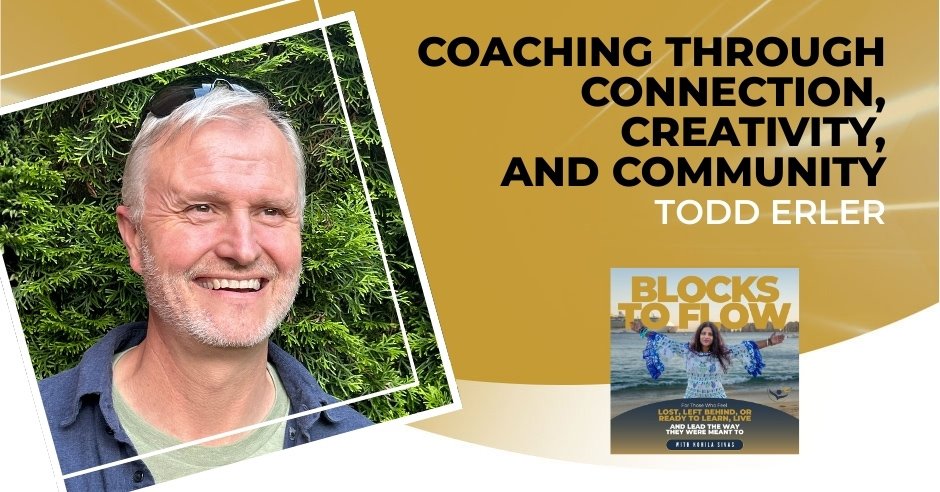
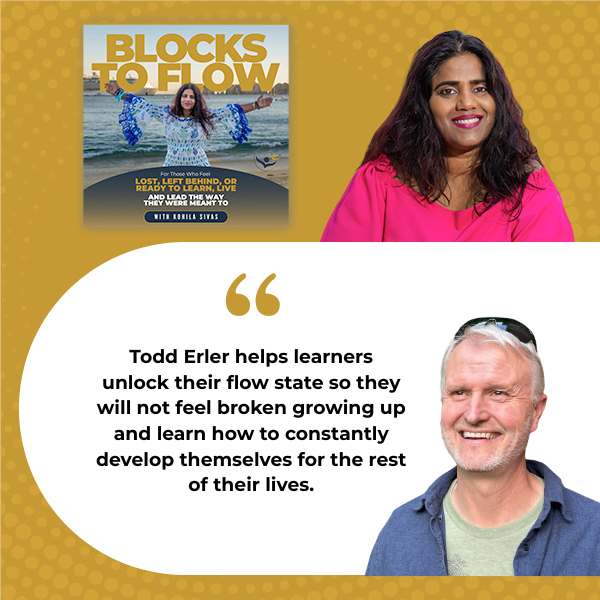
Education is not just content but a community. In this inspiring, joy-filled conversation, Todd Erler shares how creativity, presence, and authentic relationships shape his work as a classroom teacher and a Wholistic NeuroGrowth Success Coach using Blocks To Flow. His stories reveal a teacher who does not just instruct but actively listens, adapts, improvises, and brings learning to life. Todd also opens up what it is like to grow up at a traditional East Coast summer camp and his experiences performing music and improvisation. If you have ever believed that kids learn best when they’re connected, creative, and cared for, this episode will feel like home.
---
Watch the episode here
Listen to the podcast here
Coaching Through Connection, Creativity, And Community With Todd Erler
Hello, Coach Todd. Welcome. How are you?
I'm great. Thank you. How are you?
Benefits Of Doing Rounds Of Grounding Breathing
I am very good. Todd, when we begin our chat in this conversation, I always like to ask my guests to share with us something that they do to ground themselves.
I have a few practices. One, I love the breathing that we often do together as coaches. Sometimes, it's the four by four. Breathe in, hold for four, and breathe out for four. Sometimes, my body needs more of a four by six. I'm breathing in and holding and then breathing out for six. That's an easy practice. I also meditate. I am finding a space, even if I have two minutes, just to sit, focus on my breath, and stare into the middle distance. I often find my mind is trying to solve problems at the same time. I'll talk to my brain and say, “Not right now.” I'll do that in a few minutes. Those are two ways that I like to ground myself.
You're saying when you're actually meditating, you're telling your brain not to go here or there, but stay here.
Yes. My brain will say things like, “You need to make sure you answer that email or write that note.” I'll say, “Not right now.” Usually, after two minutes, I get going and do the things that I need to do.
Let's do two of those rounds of the grounding breathing. Most of the time, a lot of our coaches and a lot of the conversations I have, they do share the breathing. Breathing is such a perfect way to rest our nervous system. You said four in, four hold, and six out?
Yes.
Let's do that. Hold for four and then exhale for six. Let's do it one more time. Hold, then exhale for six. It is so amazing to start with breathing, too, when we're in any meetings like this, for those of you who are reading. It's so great to start any conversations with even loved ones. Start with the breathing. Let's calm ourselves down. Do you put your feet on the floor when you're breathing?
I do. I put both feet on the floor and ground in a little bit to that as well. I'll do it with my students. I'm a classroom teacher, so I'll count off on my fingers while they're doing it.
You shared that. Can you tell us about that, counting on your fingers?
If it's four, then one, two, three, four. They follow along with that. Kids are funny. The first couple of times, they were like, “What are we doing? This is weird.” They were trying to be all goofy with it. Over time, their bodies are like, “We like this.”
The buy-in is sometimes hard. You're teaching middle school, right?
Third and fourth graders, actually. I used to teach middle school, but this year, third and fourth. The buy-in can be hard, but you need consistency over time. Eventually, they are like, “This is the thing we do.”
With a lot of these things we do as coaches, too, it's the conviction. We know it works. When you do it with that conviction, even the people who are not buying in, our students, or sometimes adults, too, the conviction is always contagious.
I say to the kids, “This isn't just a kid's thing. I do this. Healthy adults do this. This is not that I'm doing a goofy thing with you, guys. This is how we get back to baseline.”
That's so important. For us, we never learned that this is a living system. It's a breathing system. Our breathing is very important for everything because if I hold my breath, there's no oxygen. There's no brain. The brain can't work. It doesn't have the fuel to work anymore. If we understand this as a living system, it makes sense how important what I'm doing is. It's not just breathing. It's breathing.
I teach my kids all about the connection between their brain and their bodies. I like to use my hand. I tell them, “This is the amygdala. It tucks underneath the prefrontal cortex. You have one of each.” We physically do it. I say, “When you are stressed or anxious, you flip your lid, and your amygdala takes control.” I give them those physicals. Sometimes, when they're wild or crazy, they all know what that means. “Yes, that's where we are.”
Integrating Improvisation In Classroom Strategies
You do a lot of improv, right?
I do.
How much of that do you use in the classroom?
I use a lot of it, but I don't tend to do a whole lot with the students. Sometimes, I do it for writing. Talk about active. It gets them so active. I have to plan specific times. Otherwise, the rest of the day can be very challenging. I've basically said, “Go for it. Let your body and brain do what you want.” They're like, “Wait, what?” It's carefully scripted when I do it, but I love to do it as a lead into writing a lot of times with kids. They love that.
Do they ever want to practice with you in that way?
You mean to do improv with me?
Yes.
Yes. They would do it all day. If that were the only thing I needed to do, that would be a fun way to spend a day.
There are fun ways to teach them, too. The material could be taught, too.
Yes, absolutely. There are a lot of ways. If we're doing a concept of the intense math, and it's getting like, “Wait, what are we talking about?” If I physicalize it with them, then that can help them. As adults, sometimes, we try to live up here, and kids don't. Kids live fully through. You can see this when they're expecting pizza for lunch, and it's lasagna. They don't go, “Ah.” Their whole body falls. They feel the whole thing through their body. I'm not a teacher who has kids sitting at desks all day long. We move a lot during our day.
I love your class now. I want to be in it.
It's a ton of fun.
Make Things Calmer By Getting Into Your Flow State
Sounds like it. Especially grades three and four, it is a good time for imagination to bring it out. When you think about the phrase “blocks to flow,” what moment in your life comes to your mind first, Todd?
The idea of blocks to flow is where I've felt my own blocks in life, whether they were money blocks or creative blocks. When I was learning to be a teacher, I was already an improviser. I already did improv. I know that when I'm in that space in my body as an improviser in that headspace of being like, “This may not be the way I think it's going to be. This might go a different direction, or something else might happen that I don't expect,” and I say yes to that, that puts me into that flow state.
I was very aware of that already as a teacher, using improv, and that way of teaching with myself as an individual and in small ways with kids as well. As I move through my day, I think about, “What can I open up in these moments?” You've talked about the doors. I connected with the idea of when you're stuck with a problem, what are the different doors you might open? For me, that resonated because that's improv.
How can I open this moment and accept what's happening and then work with that energy rather than get tied up in a “I wish it were different, or I wish something else were happening.” Whenever I've found myself in that energy in my life, it feels very blocked. It feels trapped. As soon as I say, “I thought it was going to go this direction, and it's not,” I can fight that, but then I'm going to hit wall after wall after wall. If I accept and go, “That's not the way this is going to unfold. It's maybe going to unfold this way,” that helps me to move around those blocks.
You're also a musician. That performance is definitely a flow state.
Absolutely. A hundred percent. When I'm playing on stage, I play mostly Irish music. It's fun. It's upbeat. It's energetic. I like to say even depressing Irish songs are pretty upbeat and fun. I'm in that flow state for two and a half or three hours. In those chunks of time, time will pass very quickly.
In that state, even in music, you're able to solve problems that come along. Even if somebody is off, you're able to correct because the flow is easy to maneuver. It's like water flowing through.
That’s so true. If something messes up in a song or whatever, you just move around it. The audience doesn't know.
If I drop it and go, “I may have made a mistake,” now we've lost the whole audience. We don't acknowledge it, just like water would pass by some rock that comes in its way like an obstacle. Music is the same. Music flows. It's a beautiful state when we are able to find a flow in our lives.
It makes things so much easier and calmer. Things you didn't expect appear when you're in that flow state. Even coming to this work as a coach came through as a flow state for me, because I've been teaching for 28 years. I'm staying in the classroom, but I'm also looking ahead and thinking, “At some point, I won't be a teacher. What am I going to do?” As I opened that possibility up for myself, the information came across about coaching and the Blocks to Flow practice. I was like, “That's it. I want to do that.” I felt that energy. That's what happens in flow. It's like, “Let's go that way.” It has been a great journey.
Getting into your flow state makes things so much easier and calmer.
That came from that flow state of opening a possibility of what else I could do beyond being a teacher, and how I can continue if I'm not in the classroom to help kids and families come into themselves. That has always been my goal as a teacher. It is to help kids. I always say to my family and my parents, “When I'm working with kids, I'm not just teaching kids. I'm teaching future adults.” That's how I look. That's how I talk to kids, too. I say, “As you grow, as you progress, and as you mature, these little skills that I'm giving you are foundational pieces so that you can go out in the world and do what you want as an adult to the best of your abilities.”
Helping Children To Get Ready To Learn
When would you say you had that realization that “I need to build something for my future?” These doors or possibilities are out there. What was the turning point? Was it when you started thinking about your future? Was that it?
Yes, definitely. It came from that place where, as a teacher, I serve kids and families. I have a specific job as a teacher. I have a curriculum that I need to deliver. There's some social and emotional learning, but it's mostly like, “How do I move 25 kids all going in one direction?” A couple of years ago, I had a student who was such an amazing individual. What a great kid he was, but he struggled day to day in school. It broke my heart because I could tell that he didn't have the prerequisite skills he needed to be successful at school.
He didn't have those. No one had downloaded that system into his body. Here he was, as a fifth grader. I was teaching fifth grade at the time. Talk about blocks. He was trying to figure it out and did not have any of the skills. I thought if there was some way I could spend some time with just him, not the 24 other kids. I could, in tiny bits and pieces, but it never felt like it was enough. When I encountered the one-on-one coaching, I thought, “This is the way that I can reach these kinds of kids.”
That's what inspired me. It's those kids who feel like school isn't their thing. It's not even school. They'll even say, “I don't like learning.” How is that possible? You're a human being. This is what we do. If I can help those kids figure out the ways that they can move through their day with more ease, they can spend time talking to their own brain and say, “I can do this.” It is that positive self-talk that grounds their own body. Those are things he needed. We did little things here and there. Yes, his next year was more successful than his last, because we were able to onboard some of those skills.
If kids can figure out ways to move through their day with more ease, they can spend time doing positive self-talk with their brain that grounds their bodies.
That's the big missing link in our classroom. We expect everybody to come and arrive at the classroom, ready to learn, with that readiness prerequisite. The readiness to learn is getting ourselves settled and entering the flow state, because only in the flow state can anyone learn. Before that, it's all pressure. When I'm not in flow or even mildly in flow, I'm rejecting because my nervous system is off, and I want to do other things. Even in the new year of school, if we could start with less curriculum and start learning about how we become ready to learn, my vision is to have that part of the school system. Every child who is coming like that boy could feel like, “Nothing is wrong with me. I'm just not ready yet.”
That would be the message I would want, and the message I would want to give him and his parents. He's not broken. It's not about whether he can't or doesn't want to. We're putting him into an environment. We use the car analogy sometimes. You're sitting in the driver's seat. No one has taught you how the car works, and it’s like, “Go.” I like to say to kids they're standing outside of the car, pushing it. Some kids who might have had some of that, or a little bit of some of those prerequisites, are driving. Those kids are going, “I must be broken. I don't know how to do this.” I want to say, “No, you just haven't learned it yet.”
That's what we want to bring into other people's lives. That's our mission, to bring this to 1.5 billion humans by 2035. It is to make sure that they don't learn that they're broken or that they can do this, but they just need to get ready. Every readiness looks different. You spent 28 years, so you know how many of the students you've seen. Every student is different.
Every student is different, even students from the same family. I often teach siblings, and they're so different. At school, because we have 20 to 25 kids in a classroom, we have to treat them all the same. You have to teach to the middle of the bell curve, but that doesn't serve those kids who aren't ready yet.

Authentic Relationships: Every student is different, even those from the same family.
How Parents Should Teach Their Children With Grounded Curiosity
Family structures have changed over time. I got divorced. My son was sharing two households. A lot of fathers might be reading. You're a father as well. To get our kids ready in two different houses, because they share the household, it's a unique and delicate balance, right?
It sure is.
It is like juggling lots of balls at the same time and becoming an expert at it. At the same time, we don't know how it all works. What would you say to a dad who's reading this right now, if he is in that situation, where one of the parents wants to see through this, like, “My child is not broken. My child needs to get the Readiness OS into them to ground and flow,” and the other parent is not buying that? It's more behavior.
That is tough. It is to the best of my ability to work with the co-parent to talk through. I find it's helpful to be curious. I am also divorced. I have a partner, but I've spent a good portion of my parenting time being a single dad and working with my co-parent. Approaching it from a grounded curiosity is the best. I always like to say, “What are you seeing? This is what I'm seeing,” and compare those notes. I am incredibly blessed in that my daughter's co-parent and I have good communication, but it's tough. I've seen parents where communication is not happening very smoothly. It's a hard road. You have to gently insist.
It's important for parents to look at this as whatever you would have done together, that should never change because you're separate for that child. Whatever you've done together should remain intact because they're still your daughter or son. Just because you're separate doesn't change the way we're going to assist my child. As you said, be curious about what's happening. What do you see? What am I seeing? Here's what is going on. If there's a difference in that, we should come together as much as possible, so our kids see a unity versus parents going this way.
I was very lucky, even in the process of splitting two households. My co-parent and I insulated our child from anything that was happening between us. Even to this day, she doesn't have that sense that Mom and Dad are against each other. She sees us as that unified piece. She's a middle schooler, so she likes to poke things. She'll even say, “Mama would do this.” I go, “No, I've talked to Mom.”
Unlearning The Unnecessary Grind And Learning To Rest
They love to do that. It becomes stronger when you say that. Was there anything hard for you to unlearn or break as you became a Blocks to Flow coach in your life, Todd?
Sure. I had to shift the way I thought to a more holistic view of working with kids. I've always had some of that, but what I needed to unlearn were pieces around what behavior means for kids. When we're seeing things like misbehavior, “I didn't do my work,” or “I didn't turn in my homework,” instead of looking at it as, “What's wrong with this kid, or what's wrong with this family,” it's more like, “What got in your way?
That is a great conversation I have now with kids all the time that I didn't have before as a teacher. When kids might say, “I didn't do that. I got grumpy about this thing,” I'll often say to the kid, “What got in your way?” That opens that conversation. It's not about blame. It's not about, “You did this thing wrong, or you couldn't handle this.” It was, “What blocked you? What stopped you from doing that?”
I've been working with a client. When this family first came to me, they said, “She's smart. She's very talented, but she procrastinates a lot.” As I began to talk with her, I would say to her, “What got in your way?” The kid and I quickly realized it's not procrastination. She had no time to rest. She was go, go, go all day and was trying to push her way into getting something done homework-wise later in the afternoon or evening after going all day long.
It was that conversation, “What got in your way?” She would say, “I had dance, and then I got home. I was exhausted.” I was like, “ That makes sense. She relaxed. She was like, “I'm not a procrastinator.” I said to her, “You don't procrastinate. Your body is telling you to stop.” Once we started that, we didn't even have to change her schedule. She went, “Wait, I could rest here. I could do this instead of that.” She articulated that.
She said, “Maybe instead of doing that, I could spend some time playing with the cats.” I was like, “What would feel restful to you?” She's like, “If I were curled up on the floor with the cats for ten minutes.” I was like, “Let's try it.” She did. Probably 50% of solving that problem was changing the message in her own mind, “I'm a procrastinator,” to “I'm a kid who has a lot going on. Every now and then, I need to rest.”
It's okay to rest. That's the thing with us giving names, and then it goes on to the labels more. It becomes significant. We get a label, then the child starts attaching to that label and makes it part of their identity.
It can be valuable to say, “This is what's going on in my brain,” but what is super important as a coach is to say, “Now what? You have ADHD. Now what? What do we do about that?” It is not just, “I guess you can't do it.” There are people in wheelchairs. Now what?
For example, somebody breaks their leg. Even my mom broke her thigh bone. It is the same procedure. She could have kept saying, “My bone is broken. I can't walk. No, that's it.” Instead, the therapy is daily to get up and take a few steps. Just get up, sit up, and stand up. It's the same thing with anything like ADHD or autism. We can look at it as it's helpful, but then what's next? What's my next step?
The value comes in allowing a kid to realize, “I'm not broken. My brain works differently.” Now we know your brain works differently. It doesn't work like this. It works like this. Now what? What do we do about that? That quickly moves the conversation away from shame and blame and “I'm this way.” I do still encounter those kids as third and fourth-graders. I was working with a student who said, “I'm sorry. I can't do that. I'm tired.” I said, “Let's rest for a minute.” We rested. I said, “Now what?” He was like, “I think I can do it now.” I said, “Great.”
That's such a beautiful space to give him because nobody would say that. Most of the time, we don't.
Most of the time, “I don't care if you're tired. This is what we're doing right now. Get back on it. Push through.” That's how I grew up with those messages. Talk about unlearning. I had to unlearn the guilt that I feel every time I rest because I was raised in a household with a dad. I love my dad, a hard worker all his life, and my mom as well. I don't think I ever had a concept that adults got tired and needed rest. It took me many years to realize that when I'm tired, my emotional response to that is guilt. I had to unlearn that, which has been powerful.
You're not alone in that because we're performance-based. Unless we have enough performance to prove it, why would we rest? Keep going until you have enough performance to prove your worth, then you might think about resting while thinking about the next performance.
It is why some people work hard until they're ready to retire. They retire, and then they pass away within a year or two. You read about that all the time. I have to think it's because they kept pushing through and pushing through. When their body finally rested, they were done.
Many people pass shortly after they retire because they kept pushing through. When their bodies finally rested, they were already done.
Retirement false belief is the hardest one to unlearn to work, and then you retire and enjoy. I don't know how much you can do when you're 60 and 65 versus when you're 40, and what you can even eat. I had to unlearn that. I'm not waiting until 65. I can't do that. Sorry. It is not going to happen in my life. I need it now. I'm going to enjoy it now as I work. Why not? I was living in Cabo, Mexico. There were so many retired people. I felt like many of them have empty lives at 65. I don't want to be that person.
All they did was work. They had nothing else. They performed their whole life. Suddenly, that's taken away. Now, who am I?
It is such a withdrawal. I cannot do that. I'm happy we're both enjoying our lives and doing what we need to. I love the story you shared about your student. That's the beauty of it. You said the holistic approach allows us to look at the 360-degree analysis of what's happening and away from any labels that are already placed and shift.
When he said, “I can't do this. I'm tired,” I said, “Okay.” I sat with him for a second. I said, “Let's rest.” I had a little space there to be able to do it. Other kids were working around us. This was work time. We sat for a sec. I breathed a little bit. I didn't even say, “Do you want to breathe?” I did it myself. It didn't take very long, maybe 30 seconds or so. I said, “How are you doing?” “I'm still pretty tired.” I could tell he had started to ground a little bit, that morphic resonance. As I started to ground, he started to ground. I said, “Okay.” I calmly said to him, “Now what? Are we ready? Can we do anything?” He was like, “Yes, I think so. I think I can do this.” If there had been more pushback, we would have come up with it.
“Try again. What else do you need?” If a kid can take a rest for five or ten minutes, come back, and do half an hour of work at full acceleration, I'm happy.
I have a spot in my classroom called the take-a-break chair. At any moment, if I'm directly teaching them something, I might say, “Not right now. It's not a good time because you want to hear this,” but kids do this. They have a little signal. Right at that chair is a five-minute timer. They flip the five-minute timer, and then they come back.
Embracing A Feeling Of Existential Safety
Structure everything. When your body asks, ask for it. It teaches so many things not to feel guilt like we do. These kids are going to feel no guilt in taking a five or ten-minute break when they need. It's beautiful. Thank you for doing that. If your younger self were to witness who you are now, what do you think they would notice first about Todd?
My younger self, because of my background, would notice that I'm safe. I spent a good amount of time growing up in the '80s. I was a latchkey kid. Again, my parents are fantastic. It was the time. I'm not criticizing how my parents operated. My parents got divorced. In the '80s, when that happened in America, you saw your dad every other weekend. That's how it went. I went through a good amount of time not feeling safe.
It wasn't that I felt like I was going to get mugged, robbed, or anything. The best way I can say it is an existential safety, a feeling of, “Am I going to be okay?” I'm okay getting a little woo woo with you. I have visualized my younger self and had conversations to repair that piece to myself, where I've said, “I've got this. I'm able to handle this as an adult.” That little eight-year-old Todd still lives inside me. He gets nervous.
We all do. We all have our own inner child.
He gets scared. “Am I going to be okay?” I have to say, “No, I got this. We're going to be okay.”
That's the power of talking to ourselves.
Yes. It's very much talking to your brain. I have a client who calls it her two-year-old brain. She said, “I have a brain like a two-year-old.” I said, “We all have two-year-old brains.”
We can call them a roommate or a two-year-old with a lot of tantrums. Out of nowhere, you're like, “What are you doing right now? Who are you? Where are you coming from? I'm fine. Leave me alone.”
I do that. I talk to that younger self when I get anxious about things. I say, “It's okay. I'm safe.” My younger self wouldn't notice that about me. We'll go, “Wait, I made it that far. I'm doing pretty well.”
The younger self also will know you have the capacity to ask, “What do I need?” without that guilt. Even if you needed a break, you couldn't give a break to find safety in your life because you had to go. We're all on a treadmill. We've got to go. The only button we have is the go button.
That hit my twenties 100%. I can be a bit of a people pleaser. It's like, “These people need this thing done, and I'm exhausted. Who cares? Go do the thing.” I've had to learn, “Nope.” For a long time, my message to myself was, “Put on your own oxygen mask before you assist somebody else.”
Put on your oxygen mask before you assist somebody else.
How can people connect with you? The beautiful thing I'm learning from you, Todd, on this chat is that it's so amazing how you coach and how you're doing it within the classroom. You're already doing it, which is amazing. I've been in a classroom for a long time. Our vision is to make sure that all kids have this early enough so that in our 30s, 20s, 50s, and 60s, we don't have to feel like we're broken and do personal development to develop ourselves for the rest of our lives. We don't need people to think that and exit high school or university. You're already doing it. That's amazing.
Get In Touch With Todd
How can you connect with Todd? He does offer Blocks to Flow coaching. He can assist with the subject as well. More importantly, if you're a dad reading this, we talked about having separate families. A lot of the time, what dads do is they don't share. It is part of the cultural conditioning. If you're a guy, you've got to be tough. You don't share stuff. Our children don't come with a parenting manual. They just come into our lives. If you're going through something, having coaching with Todd would be amazing because he's got the experience. He's doing it. Also, with Blocks to Flow, it doesn't matter what part of life you're in or what stage of your life you're in. It gives you tools and strategies so that you can stay in flow as much as possible.
Working with dads would be powerful because there's a lot of undoing of some guilt in there. Also, it’s generally what you said. We don't share. We shut it down, shove it in, and go get it done. That's a recipe for toxicity in your own body over time.
Talking about it is not a weakness. It's actually a strength.
You can't solve it if you don't know what's there. People my age and a little bit younger and older weren't taught how to access those emotions. We were taught, “You don't cry. Rub a little dirt on it, and get going.” That wasn't healthy. That didn't lead to a healthy relationship with anybody else, ourselves, or with our kids. That's powerful work.
Flow Is The Awareness Of Possibilities
Please connect with him because he is amazing. He can help you. Todd, we always end with this. Finish this sentence for me. Flow is?
Flow for me is the awareness of possibilities. I talked about opening up. It's like, “I could go this way.” We haven't mentioned this, but I was a raft guide for about ten years. You would hit a rapid, and you let the possibilities guide you down. That, for me, is flow. Maybe I'm blocked. Maybe this isn't going to work. If I move around in this direction, maybe I'm not thinking about it in the right way. If I look at those other possibilities, that to me is flow.
Beautifully said. I love that analogy. Life is not going to be an easy ride. We never said it's a smooth river we're floating on.
Can't you guarantee me that? Come on.
It is definitely a trap. You've got to find out how you're going to maneuver through all of those obstacles. Can you say it one more time? Flow is what you said?
Flow is being able to be open to the possibilities.
Thank you so much. Thank you for sharing. Thank you for all the work you've done, are doing, and will do.
Thanks for the invitation. Thanks for the opportunity to speak. This was a great conversation. I loved having this conversation with you.
Thank you so much.