
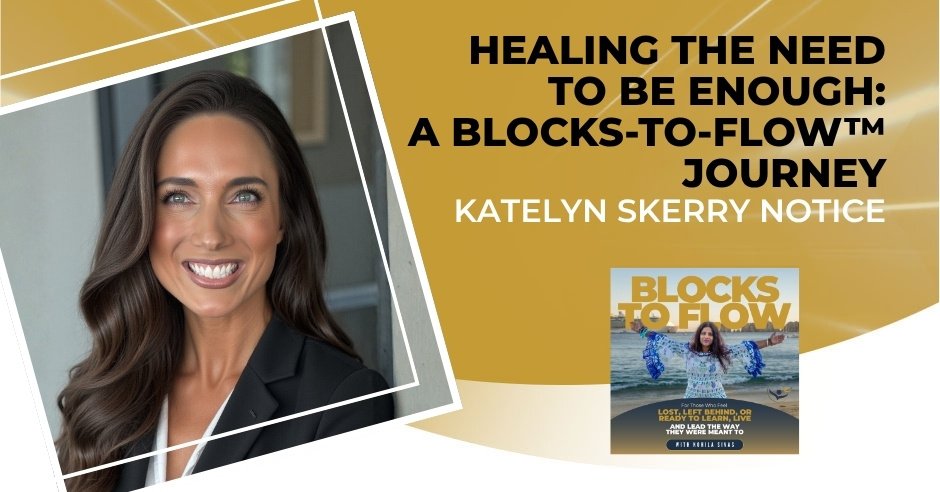
Blocks-to-Flow™ offers a powerful reminder that the path to peace begins with awareness. In this heartfelt exchange, Coach Katelyn Skerry Notice reflects on how years of control, perfectionism, and the need to prove her worth kept her in constant motion and anxiety. Through yoga, gratitude, and the guidance of the Blocks-to-Flow™ program, she discovered what it means to breathe deeply, slow down, and live in alignment. Together with Khalil, she explores the roots of self-judgment, the importance of loving yourself as you are, and the freedom that comes when you release the pressure to perform. This conversation invites listeners to see that flow is not found by chasing achievement but by remembering that you are already enough.
---
Watch the episode here
Listen to the podcast here
Healing The Need To Be Enough: A Blocks-To-Flow™ Journey With Katelyn Skerry Notice
The Grounding Breath: Starting With Awareness
Coach Katelyn, thank you for coming in. How are you?
I'm wonderful, Kohila. How are you?
Very good. I like to start our Blocks to Flow show with the grounding exercise, which is to breathe. Have you noticed that? I don't know if you have, but I have noticed that I started breathing through my mouth more than my nose. I take this kind of breath. I wanted to take three breaths with you and all of us, all of you who are tuning in to us. Take it with us, but through your nose and out through your nose. You have to do it very consciously because sometimes we do tend to do it through our mouths. Let's do one through our nose. The exhale is also through your nose, not through your mouth. Let's do another one. What difference did you notice when you're breathing through your nose and out through your nose? Do you feel a difference?
In yoga, we call this Ujjayi breath, which means ocean breath in Sanskrit. It is different for sure.
Do you notice yourself breathing through your mouth?
Not really. No.
You’re a yoga teacher. Maybe you have more awareness than most of us do. I'm not a yoga teacher myself. I've been doing it through my mouth, and I'm retraining it. It's pretty interesting to notice that you're doing that so naturally and automatically.
It’s just that my breath is shortened. I definitely notice that now. I know that's usually associated with my heart rate increase. It’s usually associated with some sort of stress. I’m noticing those things, so I can bring myself back to center. I agree.
Blocks-To-Flow™: A Personal Journey
I have a question for you. When you think about the phrase Blocks to Flow, what moment in your life comes to mind first?
Thinking about when I was blocked.
What moment in your life comes first?
Honestly, I think it was a whole era. It was this big phase of my life. I would say years probably 3 through 10 or 11 of teaching. When I was first teaching, I was still moving incredibly fast. I was so inspired. I was definitely more in a flow state. I heard Ruth describing earlier, sometimes it can be a faster or a rapid flow. Maybe that was where I was at then. When I think about being blocked, it was years 3 through 10 of teaching.
What age are you talking about?
Probably aged 24 or 25. Age 30 or 31. It was significant. It was a long period of time for me. The block was the control, primarily. Perfectionism was definitely in there, but control in that I felt that I needed to be in control of everything in order to feel safe. I also, and this is tied in with the perfectionism, had that hustle to prove my worth mentality. The real block underneath that was not enough. I'm not good enough just as I am. I have to prove it. I have to achieve it. I have to do something to show that I'm worthy of even being here. It took me a long time to dig that up and unroot that block, and look at it.
Unearthing The Roots Of Control
At that point, when you were 24, moving forward, you were living on a block that you created. It didn't start then. It has some roots somewhere else. Let's go further back. Where do you think that control started?
I think it began at home. I'm blessed with a beautiful relationship with my father, but he left my home when I was six. My first real-formed memory was him walking out the door. It was very traumatic, very dramatic as well. I was physically gripping onto him to try to get him to stay, and I couldn't. Moving forward from there, my mom was a single mom with three kids. I didn't trust her decision-making. I didn't feel very safe. I didn't feel aligned with her, and she was my primary caretaker. Because I had no control, I felt so out of alignment, unsafe, and constantly anxious. Transferring that into my adult life, I still felt that way. I thought if I could take control of things, then I would be safe. That went out into all areas of my life.
It’s so important to go to the root and begin there. If you begin when you're 24, like many people do, personal development usually starts around that age or a little later. We then start blaming ourselves that we created, but there was a significant event in your life that you felt like the most important person that you could trust and had control left you. You were then with the person whom you didn't trust. That gave you ownership that, “I need to be in control of this. Otherwise, I'm not safe.” It's a big responsibility for a little person. The block kept you safe in your own way, but then you became a hostage by the age of 24.
What were some of the feelings? I want people who are tuning in to us to connect with you. A lot of the time, feelings are not shared. It's supposed to be held inside of you. It's like your private thing that you deal with. I'm bringing the feelings out into the world. Let's not just talk about it, but let’s talk about it in a way that we feel it. What were your feelings when you were in that massive control over everything at 24, moving forward? What are some of the things you live with on a daily basis?
The Daily Struggle: Living With Anxiety And Control
Massive bouts of anxiety. I would wake up every morning and already be in a panic. I made to-do lists that were so long that they would be impossible for me to finish, and then I would shame myself when I didn't finish them. My boundaries were very poor. I was overly invested and attempting to control, in an inappropriate way, other people's outcomes. My students, my athletes, I kept my cheer team at the school, practicing until 8:00 or 9:00 at night because things weren't perfect. I wanted them to be perfect.
When kids weren't improving at the rate that I wanted them to, I would lose my mind. I would be shaming myself, feeling like it was my fault. What have I done wrong? How did I lose them? How could I do better? I lived with so much heaviness, so much guilt, so much shame. On the flip side of it, this anxiety that would drive me to go, go, go, move, move, move, do more, do more, do more, and it was never enough. I was living in a state of panic.
Also, during that time, and I don't shame myself for this now, but I did back then, too. I had so much trouble turning my mind off. I was having trouble sleeping. My health was suffering because of it. I began doing unhealthy things like drinking wine at night to try to turn my brain off, almost depending on that to get to sleep. I start everything over in the morning. It was panic, panic, panic, run, run, run. No matter what I did, it was never enough. It was never enough for me. The results I thought I wanted in this control-based world I was making up never came.
That's the resonance. If you create that chaos for yourself and you exhibit it, that's the energy you were sharing with others. They're going to perform based on that energy as well. You never actually win in that because we shared the same. They come into us at the same energy level, and then we're doing that spiraling.
It was chaos inside as it was chaos outside.
The Pandemic's Impact: A Turning Point To Peace
What was your turning point? When did you go from that chaotic survival mode into starting to feel peace? When was that time? When did it happen?
I had a couple of realization turning points. I would say the pandemic was definitely a big one because it was difficult for me to wake up in the morning and be like, “No one needs me. What do I do? Why am I even getting up? What is my life even worth? Those were scary moments for me. Yoga was the biggest turning point for me. I know I would not have found this program and aligned with this program with Blocks to Fow if I had not changed internally to be able to be in alignment with that.
Yoga was huge for me. A friend brought me to a class when I was in a chaotic place. Coming out of Savasana at the end, which is the final resting pose for yoga class, my mind was clear for the first time that I could remember. My body felt calm instead of this constant buzzing and panic. The panic you experience is not just in your mind. It's in your whole body. It was the first time that I felt that very clear nervous system, body-mind calm. I was like, “This is possible.” I can continue moving towards it from there.
Coming out of shavasana, my mind was clear for the first time I could remember, and my body felt home.
Education's Flaws: Why Kids Are Shutting Down
How did the Blocks to Flow training come into play after the yoga?
I had been teaching meditation and yoga for two, almost three, years when I found Blocks to Flow because I also switched my position at the school. I went from teaching math to becoming a PE and health teacher to start a mindfulness curriculum at my school, which was so amazing. Working in a school building, I have done a lot of internal work. Also, my external space was reflecting that. The structure of a school building is still survival-based. The way that we've set everything up is still survival-based.
I was feeling a strong sense of misalignment with that. I am an extremely creative being. We all are, and that's the other thing. For years, I would have said, “I am a math teacher. I'm not creative.” I'm so creative. I create all the time. Now I embrace and understand that, but when I'm in a creative flow, it's challenging to work with a school system that is go, go, go, do, do do. “Here's the bell. Now, do this.” Here's the next bell. Now, do this.” It was such a misalignment.
Honestly, I teach high school, and especially in secondary education, we need to do something different. This is not working. We're losing our kids. They're disconnected. They're shutting down on a mass level. I was observing that, and feeling very helpless within the system that's reinforcing that within them. I read your book, and I cried in so many chapters because I felt very seen. There were so many sections that described what a teacher's day looks like. Yes, that is unreasonable for teachers and students, and then seeing that there's someone else on the same page and a whole movement of people.
We need to change. Education needs to change. Our kids deserve better. We deserve better, and we need to understand that our lives are not built on achievement. Also, the longer I've been in education, I'm realizing more and more that academic achievement is not a determinant of life success in any way. There's not even a correlation. I have excellent students who will go on to college and drop out after their first year because they're depressed. They feel disconnected. They don't know what they're doing or why they're doing it. They don't feel a sense of purpose. It's not about academic achievement.
Education needs to change. Our kids deserve better, we deserve better, and we need to understand that our lives are not built on achievement.
That’s because they were not in flow when they were achieving. They were forced.
I was running the whole time like a hamster on a wheel. “Please see, I'm good enough. Please see, I'm good enough.”
When you run like a hamster wheel, it's exhausting. How long could you run? It's forced, but if you do it in flow, you can do it with so much enjoyment. Without enjoyment, you can do nothing for a long time. Being some things to do, do, do, I'll do it until I feel like I don't know what I'm doing. I shut down. That's what's happening to our youth and young adults right now. Many of them are shutting down because of these performance-based, forced learning environments. We have to change. We need to bring flow into their lives. Tell me more. I was enjoying your answers. Keep going so. You came into this program because?
I want change. I want to be a part of that change. I want to be a part of that movement. In education, in some ways, we've realized this was set up to sort kids, essentially, categorize kids into different career paths. It was initially set up for the manufacturing industry to create workers. There's a huge focus on compliance. There's a huge focus on rote memorization and repetition. Repetition is a part of learning, but passion, curiosity, and all of those things were so lost.
You forgot to mention creativity.
Imagination, excitement, and joy. I know as well, and I learned this during the pandemic, that sitting for seven and a half hours, I was sitting for more like fourteen hours, let's be real, because your day doesn't end when the day ends. My body wasn't built for that. My mind wasn’t built for that. I was getting back pain. I was getting headaches. I was like, “I don't know how people live like this,” and then it hit me. We're forcing our kids to live like this, actually.
I am moving around in what I'm doing in my classroom, but we're asking kids to sit down for seven and a half hours a day, pay attention, and be on the computer. We very much control their interactions, even. We then wonder why they're not expressing, why they're not showing us their full self. We're like, “What's going on? Let's create another thing pair share.” It's not. We need to break the whole system. It needs to be completely remade. This program is thinking about that from the roots, expanding outwards. That's what excites me.
The kids want to learn. Sometimes, all these labels are placed as behaviors. “Come, you're not listening. You’re that or this.” They are dysregulated. They're not in flow. They're forced to sit and listen. Anyone forced to sit and listen is going to show behaviors.
Myself included.
Me too. When I was like that, I wandered away from school. I escape the school building in my daydreams. I was daydreaming in my class most of the time. Some of us daydream. Some of us have actual behaviors that disturb the classroom. Now, we have a disturbed classroom. The teacher has to focus on that versus doing any sort of learning. Learning doesn't happen.
Even learning in the most perfect classroom right now, the way it's set up is not inspiring. We're not encouraging kids to find themselves, to find their flow, to love themselves. My big definition of flow is to love yourself. When you love yourself truly, then you're able to flow from there. In order to do that, we need to clear all of these blocks and go deep and go back, as you were talking about. Where did this come from? How do I make sure I understand now that that's not the truth? My worth is inherent. It doesn't need to be proven. It doesn't need to be achieved. It's not a goal or a checkbox that I need to get to.
Where did you feel the alignment happening in your body when it started happening for you? The flow started coming into your life. Where was it?
Alignment in my body was very much a sense of calm, peace, centeredness, and things slowing down. It's hard to explain, but I could feel it in myself. Instead of moving so fast, they started to slow down. I noticed that as I moved forward with my yoga practice, gratitude, which I definitely love to talk about, it became easier and easier for me to find that place. Going back to breathing, my breathing was slower. I could find my heartbeat and sit into it. Everything calms down.
Also, with yoga and with our program, we're so aware of all of these blocks. The community becomes aware of those blocks. You can bear and assess everything.
You have to see it. You have to be able to shine a light on it. You have to be able to name it in order to move through it and identify. That sense of anxiety that I used to experience every single day, all day long, will sometimes come back, but I can see it. I say, “I know what this is,” then I pull myself back and recenter, and then move forward.
You have to see those blocks, shine a light on them, and name them to truly move through them.
The Lifelong Process: Unlearning "Not Enough"
What was the hardest part to unlearn?
The not enough. Honestly, that in itself is a lifelong process. I can't sit here and say, “I'm totally well.” I almost said the word fixed, but that's not it. It's not enough, and seeing and recognizing when I'm moving in a way that's like, “Proof, proof, proof.” I was able to pause myself and pull back and say, “Hold on.”
A good question for anyone who's also feeling that way is to ask, “What is enough?” What does enough look like?
Being alive. My heart is beating. My belly is breathing, and I'm alive. That's enough. It's beautiful in itself, and recognizing that. Another shift for me was realizing that my energy, my life force, is the biggest thing that I have to offer the world, that I have to offer myself. That has to come first always. It has to come before anything else. This looks different for everybody, but it’s finding what cultivates that for me. What centers me in me? Those things have to come first. Otherwise, there's nothing more I can do.
Before all of this awareness and alignment and activation came into your life, what was it before? What was that? What was the bar you set that this was going to be enough? Do you remember? Where were you headed?
I can't say that it was like a goal that when I become this, this will be the thing. I felt that I had to do everything perfectly. If I did anything slightly wrong, I poured shame on myself, guilt, and frustration. You knew better what was wrong with you, and all of these types of things, instead of seeing what I could learn. I didn't actually learn as much as I could from my mistakes because I was shaming myself.
That does not stop the shame?
Yes, I can say that.
What has it shifted from shaming to what it is now?
It’s reminding myself that I'm a human and loving myself. Sometimes I have to step back and ask, “If this were my child who did this or my best friend who did this, what would my reaction be?” It would be love, of course. Why is it not for me? When I catch myself shaming myself over something, I stop, and I'll swap my position with someone that I love, and then say, “How would I treat them?” I turn around and give the same to myself.
You're teaching yourself to love yourself. Finally, you give yourself a break from not controlling.
You try to squeeze everything so tight. It's funny because I run professional development very frequently for other teachers on things like classroom management, even when I was in a place of way too much control over myself. It's a little ironic. I use the example of managing your classroom and, in ways, managing your life. It’s like holding a whole bunch of jello in your hands, like way too much jello. It's moving around. A big misstep that many of us fall into is, “I want the jello. Let me hold it.” When you squeeze it, you lose it. It's all over the place. It's gone instead of moving with it and allowing it to move, allowing it to not look perfect, but to be there, be present with it.
I love that analogy. It's because the jello is bouncing, too.
It’s always moving, just like our kids.
The Calling To Lead: Merging Yoga And Education
You came into the program, Blocks to Flow. You were called to lead that for others. Why was it a calling for you?
First, it was pure alignment. I remember being on a Zoom call with you and being like, “I can't believe I'm about to do this. I don't have the time. I don't have the money. I don't know what.” You looked at me and you're like, “It's a lot.” I was like, “It is.” I don't feel scared. I just know that this is right. That also came from building trust in myself to know that when I'm intuitively drawn to something, there's a reason for that, and I should listen. I felt called the lead others in this direction. It was like a big, bright a-ha moment with Blocks to Flow.
My yoga practice, previously, felt very separate from my school-based work and my belief in education. I want to work in education. It just needs to change. I felt like finally, those things were coming together. They finally merged, and it was offering me a path in a way to say, “I can stay in education. I don't need to leave it completely. This is a way that we can work together to support our students, to find flow, to find their creativity, to find themselves again, and to stay connected with themselves.
I went on a nature retreat, and this has cemented for me, because we were out in the wilds. No human had touched it type of space. You see the beautiful diversity of everything around you, and how everything is meant to look different. Everybody is meant to bring something different to this space. Humans are the same way. If we develop our kids in a way and guide them rather than forcing them, but offer them support, cultivate the soil that they're growing in so that they can grow to share who they're meant to be and their unique gifts. This world is going to be incredible if we stop forcing people into boxes and let them shine as who they are. The potential to change the world with that is endless.
It's tapped energy. We're tapping. We're controlling the energy of these beings, the souls of these people, into boxes. If we allow it, we have so much potential energy that we could turn it into kinetic energy, movement, force, and innovation. Innovation can be amazing. That's why we have to bring it back to where you mentioned two words earlier, which are creativity and curiosity, which have to be led through those, and being present in your body and in the moment. We're always living in the past, or we’re always living in the future. Here and now are so important. I'm excited. You came into the program. Now, you're leading other people through this program to find their blocks. Why do you feel that calling?
I think it was so transformative for me when I went through it. When I was able to find my blocks and release them, I was able to express on entirely new levels. I know that every single human has that same potential. It also hurts me, and it makes me sad when I see people who are so bright, so beautiful, but blocked. I think it's incredible to be able to set myself free, and then do the work of helping others free themselves. If we're all free, then we're in the space we were talking about.
We're blocked and boxed. People are tuning in to us. What's the evidence that I'm blocked and boxed? Sometimes we're also in denial when we're blocked. We're very good at that. What does it look like? Let's go through some of the feelings they would feel when they're blocked. You had several different blocks.
I think disconnection from our bodies is a big one. When you notice patterns of harming your body in whatever ways, that can be overeating, lack of movement, substance abuse, things like that. When you're willing to harm your body on a regular basis, you are very likely disconnected from your body. If you're disconnected from your body, it's much more difficult to be present. I would say looking for patterns of disconnection from your body because that's disconnection from yourself.
When you're willing to harm your body regularly, you're likely disconnected from it, making it much harder to be truly present.
When you check in with your thoughts, are they here and now? Are they in the future, or are they in the past? How often are you centering in your breathing and in your heartbeat, in those natural rhythms that we already have within us? I talked to my kids and my students a lot about this in terms of communication, but I think it also speaks to the present. How often are you talking with someone and instead of actually listening and holding space for whatever it is they're saying, you’re already planning your answer in your head? You're already like, “This is what I think.” You're waiting for them to finish, so then you can say what you think. You're not there.
We’re drifting to find the answer because it’s performance-based. I’m at a good company, so now I'm already performing. We're wired like that. How does alignment feel in your body now compared to when you were on in that survival, control, chaotic place? How does it feel now? You said centered.
Centered, calm. I can relax into myself. A big shift for me has been that my concept of time has changed significantly. It used to be that I was always hurrying. Five minutes is not enough time. Now, when I have five minutes, I'm like, “Five minutes. That's great. That's enough time.” I can look out the window. I can spend a moment with my dog. I can breathe. There are so many things I can do with five minutes.
Because you were so caught up in that controlling, you didn't think five minutes was a lot. As you said yourself, five minutes is nothing.
It was never enough. Nothing was ever enough.
I love it. Even two minutes is long.
Yeah, if you allow it to be. It's the same two minutes, but it's how we experience it.
You can panic and experience it in a different way, or be inflow and experience it.
That’s completely different.
Cultivating Flow: Daily Rituals Of Gratitude And Movement
What daily rhythms or rituals help you stay in flow in that?
Gratitude is a big one.
Is gratitude just saying thank you?
It can be that simple.
What else do you do?
I woke up this morning, thank you. I'm here. I'm so grateful to be here. Gratitude or myself as well, like acknowledging myself for not the things that I do, but for being me and loving myself. My daily practices have shifted so much. So much of my daily schedule is still the same. I still work in a school building. I still work you fourteen-hour days, but the way I experienced those days is completely different.
My priority every day, when I wake up, is not to wake up for school. I wake up for my life. I wake up for me. I wake up to be happy. I wake up to experience joy. I wake up to smile. I wake up to look at the sunshine. That's why I wake up. Yes, I go to school and do these things. I enjoy my time there. Some of my daily practices for me are definitely gratitude, staying in the present moment, and bringing myself back into the present moment when I find myself overthinking or moving too fast. Also, making sure that there are very clear times in my day that are for me and about me.
Movement is important for me. I've been an athlete my whole life. Movement has always been a big part of my life, but I used to go for a run or go to the gym, or do things. I was like, “I have to be better. I have to be faster. I have to be stronger.” It was forced. Now, it's because I love it. I love moving to music. I wake up, and I'll go to a yoga class, play the music that I love, and move my body. If I don't do that, maybe I'll get up and go for a walk and listen to my favorite playlist. I make sure that my days start for me. I'm doing things for myself. The things that cultivate my energy that make me feel good, those are the things that come first always.
I love it. Yes. Thank you is a powerful word. Saying thank you three times is powerful. Also, saying I love you to yourself is powerful because we don't say it enough. Especially, when we have blocks that we have gone through, like you or me, in order for me to say I love you is a huge thing. It’s a huge win.
In the mirror, too. I know. Mirror work is challenging for some people, but the mirror helps.
Mirror Work: Loving Yourself To Find Flow
You have to feel it. You have to say it and mean it because then you can see your face if you don't mean it. Catch yourself. If your younger self could witness you now, what do you think they would notice first?
The slowness. The calm.
It’s Katelyn who is with the flow, with the time.
It’s definitely moving much more slowly. The younger me would have been like, “What are you doing? You need to go, go, go. Why would you waste time?” I had so much trouble sometimes when I was younger with some of my older co-workers because they would sit and drink a coffee and talk to each other. I'd be like, “What are you doing? We could be doing things.” I must have been a lot. I moved much more slowly. I also allow myself time to process things. When I get an email or when something comes to me that I feel reactive or it starts to speed me up, I stop and I create space between myself and that thing. I might write out my thoughts, but I don't send the email. I do not respond right away. I step back.
You’re not reactive anymore. It's happening on your time. That's beautiful because that's where we get the panic attacks and the anxiety.
That heaviness, too, every time that we are in that reactiveness. I tell my students all the time. One of the things we need to remember is that when we go through something, our body goes through it, too. Our whole selves go through it. When we compartmentalize ourselves in these interesting ways that we've been socialized to do, where we're like, mentally I'm over it, then it's over. No, your whole being went through that.
Remember, when we go through something, our whole selves go through it.
Cognitively, you're okay, but your self is remembering it.
That's very heavy, especially if you go without releasing it. You're carrying around all of this tension, all of this stress, all of this reactivity, shame, guilt, and overthinking. It's so much. That's why we end up in places like panic attacks and things like that, because it builds up. It has to go somewhere. Releasing activities, I would say, is another thing. For me, movement is definitely one of those, letting things out, releasing tension from your muscles. Even waking up in the morning to stretch your body. Reach your arms up and over. Get some tension out intentionally.
That's the buildup of potential energy. Potential energy needs movement to become kinetic and be released. Release is required before we blow up with anger or whatever, however you explode. If our audience could take one simple action to step closer to awareness and alignment, what would it be?
Wake up for you. Get up in the morning and say, “I'm alive.”
I woke up this morning. How do I know I'm waking up for me? What's the difference? Everybody wakes up unless you don't know. That would be the end of the day in your life. What is the feeling when you say that? I want to know? I know you're feeling it, but we want to feel it too.
Gratitude and warmth when waking up. It can be different each day. Sometimes, I look and I see the sun coming a little bit through a window. I'm like, “Wow.” I look over and I see my husband snoring. I love them towards my dog. Just something that brings that warmth of like, “Yes, life. I'm here for me.” When I was in that survival cycle, I would wake up immediately and be like, “I need to get that done,” and start moving right away, jumping into the world and chaos and all these things. Staying with myself for a moment. Keeping your phone away for the first 30 minutes. You don't need it. Nobody needs you at 6:00 AM. That time is for you. I'm taking it for you.
That's a ritual. Everyone can set that up first. Even five minutes. It doesn't even have to be 30 minutes. Some people find 30 minutes or whatever works for you. We're not a one-size-fits-all system. I would say whatever works for you. I get up at 3:00 AM every morning, and people think I'm crazy. I'm like, “I'm not crazy. It's just the way that my body works.”
I go to, sometimes, sleep at 8:00 AM. I might have a nap, and then I have another nap at 2:00 PM. I designed my life like that. I could take those naps, but I'm not crazy. That might not work for somebody else. You don't need to get up at 3:00 AM. You get up at 7:00 AM. Those first five minutes, you say, “It's for me. I’m just going to breathe. I'm going to get up. I’m going to do something with myself.
A good way of summarizing that, too, is setting some simple boundaries that create space for you. Something as simple as choosing actively. I am not going to pick up my phone for however many minutes you set. That's a boundary. You set that boundary and create that space for yourself. When you create space, all kinds of beautiful things can come to you. They won't if you don't create the space, if you don't set the boundary. My sleep schedule is completely different than yours, but my sleep is very important to me. That's a big boundary I set. I'm like, “My bedtime is 9:30 and that's it. I'm up at 5:00, but if there's something going on, yes, I'll go to the dinner and whatever, but I'm leaving because I am protecting the time that's mine. That's important to me.
If you're tuning in, that’s one thing to center yourself. The minute you wake up, set some boundaries, so you can give five, two minutes, even a minute, or whatever works for you. Don't think that it has to be 30 minutes because sometimes 30 minutes becomes like a sentence. You don't want to ever feel like you're sentenced to do this.
That's why when people out there who are like gurus or experts say, “You have to do it for 30 minutes,” my rebellious mind goes, “No, I don't.” I have always been a rebel. “You don’t know me. I can't sit for 30 minutes because I have to do this. I have to do that.” Whatever works for you, for one minute, even half a minute, feel yourself. It is an amazing way to start. How can people connect with you? You're now a coach. You offer programs for parents, students of all ages, and adults. How can they connect with you?
For coaching conversations, via email is best, [email protected]. Please connect with me on all the socials. I have Instagram, @KSkerry, my maiden name. LinkedIn and Facebook, Katelyn Marie Skerry. I will be launching a website very soon under Whole Expansion Coaching.
Last question. Finish the sentence for me, Katelyn. Flow is.
Loving yourself.
I love it. One word that describes when you're in full flow. What is the one word that describes it?
Creation.
Flow allows you to create. Beautiful. One practice that instantly helps you return to alignment and into flow.
Breathing.
The breathing that I started today. That's beautiful, and then holding, too. Breathe, hold, and release is also powerful.
I like box breathing. Just getting in touch. Sometimes I put my hand on my heart because I could be in conversation with somebody, or something else is happening. It might be weird for me to take a deep breath, so I just put my hand on my heart and like, “My heart is beating. Everything is fine.” If my heart is beating, I'm alive. That means that anything is possible.
The Truth Of Who You Are: Releasing Blocks To Your Birthright
One truth you wish everyone knew about learning, living, and leading in flow. One truth that you wish everybody knew.
That's the truth of who you are. We all have it. We all do. That's why I love the Blocks to Flow concept. There's nothing wrong with you. You're not missing anything. I don't need to give you anything. You already have everything that you need. We're just blocked. These blocks have been built for a variety of reasons. They've been taught to us. It's not our fault. When you release the blocks, it's already there. Everybody already has it. A tree already has it. A seed already has everything that it needs, and so do we.
There's nothing wrong with you. You're not missing anything. You have everything you need.
That's the thing with personal development that I wanted to change into human development because the sole print that we were brought into the world has it everything. It's potentially everything. That's the potential of any person. It is already there. We're not fully able to express it because we're blocked or we're boxed. It could be society. It could be me. I boxed myself, too. I blocked myself for many years. That’s my own stories. It doesn't even have to be someone else’s. At some point, we have to do something about it. That's where awareness is number one. Number two, alignment. Number three, you have to start activating your systems, the nurse systems. That's how you can start into acceleration, and then achieve as much as possible for anyone and everyone. It's your birthright.
It is our birthright. We are all worthy. All of us. You're already enough, and you already have everything you need.
You should claim it. It's yours to be claimed. The only thing that's stopping you, as you said, is your blocks. Katelyn is a beautiful coach who can help you with that. Contact her wherever you want to contact her. Katelyn, anything else you want to add before we end?
This world is going to be an endlessly beautiful place when we all start to flow.
That's our goal. To reach 1.5 million families, students, adults, and young adults. I'm so excited. Young adults are so close and dear to me because my son turned eighteen. I don't know. He's leaving home. I don't know why, but I see other sons and daughters as well who are struggling with a lot of blocks. Because of the pandemic, we were isolated, too, so bringing them back and reintroducing them into the world. That put a lot of new blocks into our society, too, the separation. We need to reintroduce everyone and get them into flow. Thank you so much for the work you're going to be doing and doing. I'm so excited for you that you finally found yourself and your love for yourself.
Thank you so much, and thank you for your leadership and your mentorship, and for this movement. I'm so grateful to be a part of it.
Thank you so much.